I WAS DISAPPOINTED, to see that yesterday, July 8, had no listed feast of my Mother Mary, Our Lady. Listed was "Our Lady of Kazan," which is of the Heretics and Schismatics, who have no part in the God of Israel or with Mother Mary, any more than the Mahomettans do. Today, by contrast, seems to have a plethora of invocations of my Mother Mary! - July 9, 474: At Constantinople, the dedication of a church to Mary under the title, "Over the Well," built by Emperor Leo.
- 6th century: Emperor Justinian built a church in Carthage dedicated to Mary, Our Lady of Peace. He also built churches dedicated to Mary in Tripoli and Morocco.
- July 9, 1548: Diaz y Mendez founded the City of Our Lady of Peace or La Ciudad de Nuestra Señora de la Paz in Alta Peru or Upper Peru, now called "Bolivia" after the great Satanist and traitor.
- July 9, 1056 Our Lady of Coutances, France.
This feast day is commemorates the dedication of the Cathedral of Our Lady of Coutances, by Bishop Geoffry de Mombray, in the year 1056. According to tradition, the knowledge of salvation came to Coutances in the 5th century through Saint Ereptiolus. It is known that he built a church on the site where there had once been a pagan temple. After the destruction of the Western Roman Empire, Coutances suffered from invasions by the Scandinavians and Normans in the 9th century. The church was razed, the city abandoned, and the bishop forced to flee for safety to Rouen. They did not go back to Coutances until nearly one hundred and sixty years later, when they returned with the assistance of Duke Richard the Fearless. In the year 1030, Bishop Robert began the construction of a new cathedral, Our Lady of Coutances in the Romanesque style. He died shortly after the labor of love had begun, and it was left to Bishop Geoffry de Mombray, who had been appointed in 1048. He completed the cathedral in the year 1056.
- July 9: Our Lady of the Atonement.
Our Lady of the Atonement, in Latin, Domina Nostra Adunationis is a title of the Blessed Virgin Mary first invoked by Father Louis T. Wattson, S.A. and Mother Lurana White, S.A, the founders of the Society of the Atonement in the Episcopalian Church. Episcopalianism is the Anglican Church in the USA, after the USA seceded from England and became Independent. In June 1899 the Episcopalian Church priest Rev. Lewis T. Wattson professed his vows as a Friar of the Atonement, taking the name Brother Paul James Francis. In 1901, Fr. Francis initiated, for his Friars of the Atonement, devotion to the Blessed Mother invoked under the title, "Our Lady of the Atonement," adapting prayers to Our Lady of Sorrows. That same year, he and Society of Atonement co-founder, Mother Lurana White, established the Rosary League of Our Lady of the Atonement. In the early 1900s Wattson was a popular preacher in Episcopalian parishes, and Mother Lurana edited a small Episcopalian magazine called "Rose Leaves from Our Lady's Garden at Graymoor." This brought a greater awareness of the devotion to the Anglican / Episcopalian community. The title became popular among Anglicans particularly in the High Church movement and particularly in the "Anglo-Catholic strand" who have a similar devotion in their liturgical traditions. In 1909 the Society of the Atonement was received into the Catholic Church. In 1919, the title was formally approved by Pope Benedict XV. In the September 1932 issue of The Lamp, Father Francis wrote, "When we, therefore, give to our Blessed Mother the title of 'Our Lady of the Atonement', we mean 'Our Lady of Unity.'" Her image was painted by John Martini in 1929 and by Mother Margaret Mary Nealis in 1933. Stained glass windows at the St Francis Chapel at Graymoor also depict Our Lady of the Atonement. The Franciscan Sisters of the Atonement have a shrine to Our Lady of the Atonement near the entrance to Graymoor. The feast day of Our Lady of the Atonement, July 9, was approved by the Holy See in 1946. Our Lady of the Atonement is depicted wearing a golden crown or a crown of 12 stars and a blue tunic. The red mantle signifies the Precious Blood of Jesus. She holds in her arms the Christ Child who holds a cross in his right hand.
The Society of the Atonement, also known as the Friars and Sisters of the Atonement or Graymoor Friars and Sisters is a Franciscan religious congregation in the Latin Rite branch of the Catholic Church. The friars and sisters were founded in 1898 as a religious community in the Episcopal Church. The religious order is dedicated to the Blessed Virgin Mary under the Marian title of Our Lady of Atonement.
Lewis Thomas Wattson was born in Millington, Maryland January 16, 1863 to the Reverend Joseph Newton Wattson and his wife, Mary Electa. Joseph Wattson, a former Presbyterian, was an Episcopalian minister. Lewis received his B.A. (1882) and his M.A. (1885) from St. Stephen's College, Annandale-on-Hudson, New York. He was ordained to the diaconate in 1885, and by special dispensation, at the age of twenty-three, he was made a presbyter. Wattson was graduated with a Bachelor of Divinity from the General Theological Seminary in New York City in 1887. After serving for a time in Port Deposit, Maryland, he became a popular preacher in the New York and New Jersey area and became rector of St. John's Episcopalian Church in Kingston, New York. In 1891, he established the Church of the Holy Cross Church as a mission of St. John's, to serve working-class families living near the West Shore Railroad. Holy Cross had a more Anglo-Catholic tradition and a particular mission to the poor. Rev. Wattson resigned the rectorship in Kingston to accept a position as superior of an Episcopal mission in Omaha.
Lurana Mary White was born in New York City on April 12, 1870. On Oct. 17, 1894 she became a postulant in the Episcopalian community of the Sisters of the Holy Child Jesus in Albany, New York, where she made her vows on Sept. 25, 1896. That same year, White began corresponding with Rev. Wattson, whom she had heard was "very High Church." Wattson was at the time the superior of a small community of Episcopalian priests in Omaha. Both were part of the Anglo-Catholic Movement, also known as the Oxford Movement, which had developed in the Church of England in the early 19th century. Sister White asked Father Wattson's help in finding an Episcopalian community of religious which practised corporate poverty in the Catholic Franciscan tradition. Fr Wattson was unaware of any such community, but began corresponding with her regarding his desire to see the Anglican and Catholic Churches reunited under the leadership of the Bishop of Rome.
In October 1898, White and Wattson met at her family's home in Warwick, New York and made a spiritual covenant to form a new religious community with the aim of re-establishing Franciscan life in the Anglican Communion. (The name of the new community was inspired by a passage in the Epistle to the Romans, Romans v, 11, which, in the King James Version, speaks of the atonement Christians have received through Jesus. Wattson chose to interpret the word "atonement" in the literal sense of "at-one-ment," out of his vision that his new community should have the aim of leading all Christians to unity or oneness with one another. To this end, Sister Lurana spent a year in training with the Society of the Sisters of Bethany in Clerkenwell, London. Before her return, she made a pilgrimage to Assisi.
Rev Albert Zabriskie Gray, rector of St Philip's Church in the Highlands in Garrison, New York, was already serving St James' Chapel at Highlands and the Chemical Works on the border with Westchester when he erected the mission Chapel of St John's in the Wilderness in the southeastern portion of the parish. In 1882, Gray left Garrison to take a position at Racine College. The chapel fell into disuse and disrepair, but the trustees of St Philip's gave Sister Lurana leave to use it and a nearby farmhouse until a convent should be built.
On December 15, 1898, Sister Lurana and two companions took up residence in the area of Garrison, New York, at a farmhouse near the abandoned chapel of St John's-in-the-Wilderness. She named the place "Graymoor", combining the names of Rev. Gray, who had founded the chapel, with that of a Mr. Moore, who had been a generous supporter of its restoration.
Meanwhile Father Wattson had spent some time at the Anglican Monastery of the Order of the Holy Cross at Westminster, Missouri to gain some experience of religious life in community. Wattson joined the sisters in the spring of 1899 and took up residence in a painter's orcarpenter's shed about a mile distant. With the formal establishment of the Society of the Atonement, they embraced religious life in the Episcopalian Church. In taking religious vows, Miss White became known as Mother Lurana, while Father Wattson took the name of Father Paul James Francis. Mother Lurana became head of the Franciscan Sisters of the Atonement, the women's branch of the society; Father Paul became superior of the Franciscan Friars of the Atonement. Frederick Joseph Kinsman, third Episcopalian Bishop of Delaware, was chosen as Episcopal Visitor. The Society preached the primacy of the Roman pontiff, while keeping its Episcopalian allegiance, as they worked to realize a corporate reunion between the two bodies. Due to this, the founders and their small number of disciples came to find themselves not only criticised but ostracised by their co-religionists, who saw them as walking an impossible tightrope between the two bodies. In 1909 both the men's and women's societies chose to seek union with the Holy See and full membership in the Church of Rome. In October 1909, the Vatican took the unprecedented step of accepting the members of the Society as a corporate body, allowing the Friars and Sisters to remain in their established way of life. Now in union with the Bishop of Rome, the Friars of the Atonement continued their work of advocating the reconciliation and eventual reunion of the various Christian denominations with the Pope as spiritual leader, known as Ecumenism. A major part of this effort was the Octave of Christian Unity, an eight-day period of prayer for the various segments of Christianity. The Octave runs January 18–25, starting on the date that — at the time — marked the Feast of the Chair of Saint Peter at Rome, and ending on the Feast of the Conversion of Saint Paul. This period is now known as the Week of Prayer for Christian Unity.
- Our Lady of Aberdeen in Scotland also known as Notre Dame du Bon Succès.
Our Lady of Aberdeen is a Madonna and Child statuette, a copy of a similar statuette in Brussels known as Notre Dame du Bon Succès. Copies of Notre Dame du Bon Succès are to be found across the North East of Scotland. It is believed that the statue in Brussels may have been in Old Aberdeen as early as 1450. References to a statue in a Chapel at the Bridge of Dee in Aberdeen suggest that it may have been placed there by Bishop Gavin Dunbar of Aberdeen (1514–1531). At the beginning of the Scottish Reformation (c. 1559) many religious objects from churches in Aberdeen and the St Machar's Cathedral in Old Aberdeen were given for safe keeping to Catholic sympathisers. It is claimed that the statue was in the hands of a Catholic family, the Gordons of Strathbogie, until 1625. It was then sent to the Low Countries by a William Laing, thought to be the Procurer for the Kings of Spain, to the Infanta Isabella Clara Eugenia in Brussels. There is a reliable history of Notre Dame du Bon Succès in Brussels from that date. In Scotland the Catholic Church celebrates July 9 as the Feast of Our Lady of Aberdeen. There are copies in St Mary's Cathedral, Aberdeen and in the Bishop's House, formerly the Convent of the Sacred Heart in Aberdeen. Other copies include one in Buckie and one in St Peter's Church in Aberdeen.
- Our Lady of Peace.
Our Lady of Peace, Mother of Peace, Queen of Peace or Our Lady Queen of Peace is a title of the Blessed Virgin Mary in the Catholic Church. She is represented in art holding a dove and an olive branch, symbols of peace. Her official memorial in the General Roman Calendar is on July 9 in the universal Church except for Hawaii and some churches in the United States, where it is kept on January 24.
The traditional story holds that in the early 1500s in France, a certain John de Joyeuse presented the statue as a wedding gift to his young bride, Francisca e Voisins. The statue was known as the "Virgin of Joyeuse," and became a cherished family heirloom. Around the year 1588, his grandson, Henry Joyeuse, joined the Capuchin Franciscans in Paris and brought the statue with him, where it remained for the next 200 years. With the olive branch in her hand and the Prince of Peace on her arm, the statue was called Notre Dame de Paix (Our Lady of Peace). In 1657 the Capuchin community erected a larger chapel to accommodate the growing number of faithful who sought her intercession. On July 9 that year, before a large crowd which included King Louis XIV, the papal nuncio to France blessed and solemnly enthroned the Virgin's statue. Pope Alexander VII would later designate this date for the Capuchin community to celebrate the feast of Our Lady of Peace. During the French Revolution, which erupted in 1789, the Capuchins were driven from their monastery. They took the image with them to prevent its destruction by the ransacking rebels. When peace was restored in the land, the statue was brought out of hiding and entrusted to Peter Coudrin, a priest in Paris. In 1800, Coudrin and Henriette Aymer de Chevalerie became co-founders of a community of sisters, brothers and priests — the Congregation of the Sacred Hearts of Jesus and Mary and the Perpetual Adoration of the Blessed Sacrament. Coudrin gave the statue to Mother Aymer, who enshrined it in a convent chapel in the Picpus district of Paris on May 6, 1806. The members were also known more simply as the Picpus Fathers or Sacred Hearts religious. Excluding its pedestal, the figure of dark hardwood is 11 inches tall, and is fashioned in the Renaissance style of the period. Mary is depicted as a dignified matron, with the Christ Child on her left arm and an olive branch in her right hand. The original statue of Our Lady of Peace was ceremonially crowned on July 9, 1906 by the Archbishop of Paris in the name of Pope Pius X. Every July 9 since then, the Congregation of the Sacred Hearts of Jesus and Mary have celebrated the Feast of Our Lady of Peace. During the troubled years of World War I, Pope Benedict XV added Our Lady of Peace to the Litany of Loreto, a sacred prayer in liturgy.
Tradition holds that in El Salvaror in Latin America, in 1682, some merchants found an abandoned box on the shore of Salvador's Mar del Sur. Unable to open it, they tied the box on a donkey's back and set out to inform the local authorities of their find. When they were passing the parish church, now a cathedral, the donkey lay down on the ground. They were then able to open the box and were surprised to find that it contained an image of Our Lady holding the Child. It is said that a bloody struggle was going on between the inhabitants of the region, but when they heard of the marvelous discovery in the abandoned box, they put down their weapons and immediately ceased fighting. This is why the image was given the title of Our Lady of Peace, whose liturgical celebration is held on November 21 in memory of its arrival at San Miguel. The statute is a dressed wood carving, with the national shield of El Salvador embroidered on the front of the image's white robe. The image holds a gold palm leaf in memory of the eruption of the Chaparrastique volcano, which threatened to destroy the city with burning lava. The frightened dwellers of San Miguel brought out the statute of Our Lady of Peace to the principal door of the cathedral, and at that precise moment the force of the lava changed direction, moving away from the city. Pope Benedict XV authorized the canonical coronation of the image which took place on November 21, 1921.
- Our Lady of Chiquinquirá in Colombia, Venezuela and Peru.
Our Lady of the Rosary of Chiquinquirá or the Virgin of Chiquinquirá is a Marian title of the Blessed Virgin Mary associated with a venerated image in the northern Andes region. Under this title, the image is the Patroness of Colombia, of the Venezuelan state of Zulia, and of the town of Caraz in Peru. The image is painted on a cotton support, is kept in the Basílica of Our Lady of the Rosary in the city of Chiquinquirá, in Colombia, where religious devotees celebrate her date every December 26 and July 9. On January 9, 1910, Pope Pius X authorised the Canonical Coronation of the image of Our Lady of Chiquinquirá in Colombia, which was not carried out until July 9, 1919 due to the political turmoil prevalent at the time. The title given to the Virgin is from the city of Chiquinquirá, where the first of the Virgin's miraculous manifestations occurred, and where the original image from the sixteenth century is kept. A later image of the Virgin of Chiquinquirá, painted on wood, can be found at the Basílica of Maracaibo, in Maracaibo, Venezuela, where it is also called La Chinita. Every November 18 the city celebrates the traditional Feast of La Chinita with Masses and processions in honor of the Virgin.
Another narrative:
«In the mid-16th century the Spanish painter Alonso de Narvaez created a portrait of the Virgin of the Rosary. He painted in pigments from the soil, herbs and flowers of the region of modern Colombia, and his canvas was a rough 44 inch x 49 inch cloth woven by local Indians. The image of Mary is about a meter high, and stands above a half moon. She has a small, sweet smile, both her face and the Child’s are light colored, and she looks like she’s about to take a step. She wears a white toque, a rose-coloured robe, and a sky blue cape. A rosary hangs from the little finger of her left hand, and she holds a sceptre in her right. She holds the Christ Child cradled in her left arm, and looks toward him. Christ has a little bird tied to his thumb, and a small rosary hangs from his left hand. To either side of Mary stand Saint Anthony of Padua and Saint Andrew the Apostle, the personal patrons of the colonist, Don Antonio de Santana, and monk, Andrés Jadraque, who commissioned the work. In 1562 the portrait was placed in a rustic chapel. It was exposed to the air, the roof leaked, and soon the damage caused by the humidity and sun completely obscured the image. In 1577 the damaged painting was moved to Chiquinquirá, Colombia, and stored in an unused room. In 1585 Maria Ramos, a pious woman from Seville, cleaned up the little chapel, and hung the faded canvas in it. Though the image was in terrible shape, she loved to sit and contemplate it. On Friday 26 December 1586 the faded, damaged image was suddenly restored. It’s colors were bright, the canvas cleaner, the image clear and seemingly brand new. The healing of the image continued as small holes and tears in the canvas self-sealed. It still has traces of its former damage, and the figures seem brighter and clearer from a distance than up close. For 300 years the painting hung unprotected, and thousands of objects were touched against the frail cotton cloth by pilgrims. This rough treatment should have destroyed it, but it healed and survives. In 1829, Pope Pius VII declared Our Lady of Chiquinquirá patroness of Colombia, and granted a special liturgy. In 1897 a thick glass plate was placed over it to shield the painting from the weather and the excess zeal of the faithful. The image was canonically crowned in 1919, and in 1927 her sanctuary declared a Basilica.»
- Feast of Our Mother of Holy Hope.
The Passionist Order has had from its beginnings, a devotion to the most holy Virgin under the title of Mother of Holy Hope. It was promoted in a special way by the missionary and bishop Thomas (Tommaso) Struzzieri, C.P., March 30, 1706 – January 21, 1780. He always carried a picture of our Mother of Holy Hope with him on missions.
- Our Lady of Itatí
Our Lady of Itatí (Spanish: Nuestra Señora de Itatí), also known as the Virgin of Itatí, is a Roman Catholic title of the Virgin Mary, whose principal shrine is in the city of Itatí, in the Corrientes Province 0f Argentina. Her feast day is celebrated on July 9, with an anniversary celebration on July 16. Itatí is a Guarani word which is composed of «Ita» (rock) and «tí» (white, for the color of the lime deposits there). The first Franciscan community settled in the Santa Ana area, also known as the Reduction of Yaguari, in 1528. The reflection of the Lady of Itatí appeared three times under a rock along a river of the Paraná Basin, which led the Franciscan settlers to erect there a statue of Our Lady of Itatí in 1589. Shortly afterwards, local Indians fought the Franciscans and captured the statue. Then questioned about the precise location of the apparition of Our Lady of Itatí, they claimed to have found another rock from which a bright light and a surnatural sound emanated. The Franciscans and the Indians agreed on a new location for the statue of Our Lady of Itati, and created the new city Pueblo de Indios de la Pura y Limpia Concepción de Nuestra Señora de Itatí. The shrine played a central role in reducing the water currents of the region to enable settlements to be built. According to legend, the wooden representation of the Virgin Mary saved the life of 17th-century Jesuit missionary, Luis de Bolaños, known for his attempts to convert the natives to Catholicism. It is also said that the Virgin intervened in a battle between two native tribes, resulting in the victory of the tribe allied with the Conquistadors. On July 16, 1900, the statue of Our Lady was granted a Canonical Coronation under the pontificate of Pope Leo XIII, who proclaimed the statue as the Patron of Corrientes, and creating the diocese of Corrrientes. In 1950, a basilica to enshrine the image was built with one of the tallest domes in South America. The shrine and its dome are one of the largest Catholic pilgrimage sites in Argentina. The wooden statue of the Lady of Itatí is 126 centimeters high. She holds her hands in a position of oration, and wears a blue coat and a white undercoat.
Collectives of Saints that are Martyrs or Isomartyrs- The Holy Martyrs of Egypt Saints Patermutius, Copretes and Alexander, martyrs under Julian the Apostate.
«The Holy Martyrs of Egypt St Patermutius (Patermuthius, Patermouthios or Pater Mucius) lived in Egypt in the 4th century. He is said to have been a notorious robber before being converted by the holy Egyptian hermit Copres (Copretes). Later, Patermutius also became a hermit with Copres in the Egyptian desert. This was in the time of Emperor Julian the Apostate (Apostate) (361-63). When the Apostate went to war against the Persians and came to Egypt, the two hermits were identified by the idolaters as zealous Christians. The emperor had them arrested and brought before him, Patermutius was 75 years old, while Copres was only 45. The tyrant interrogated them separately and tried through flattery to bring them to apostasy, which he succeeded in Copres' case. When Patermutius was taken to prison, and Copres appeared free and dressed in splendid clothes, he sighed and wept over his companion's unfortunate apostasy. But Copres repented, whereupon the tyrant had his tongue torn out and had him thrown into a fiery furnace with Patermutius. When a soldier named Alexander, who was standing guard there, saw the two saints standing unharmed in the midst of the fire and heard them praising God, he confessed Christ, whereupon he too was cast into the fire. He gave up his spirit in the flames, without his body being harmed in any way. Then Patermutius and Copres were taken out of the oven and beheaded because they remained firm in their faith in Jesus Christ. Their martyrdom took place around 363. The bodies of these three martyrs were probably brought to Rome along with the remains of Saints Cyrus and John, where they were kept in a church built in their honor in the area that later became the Jewish ghetto. When this church was demolished, the Pope St Pius V had the relics brought to the church of St Angelus. Piazza writes that the relics are partly located in St Angelus in Pescaria and partly in St Maria in Vallicella. Their memorial day in the Martyrologium Romanum is July 9, but December 17 is also mentioned.»
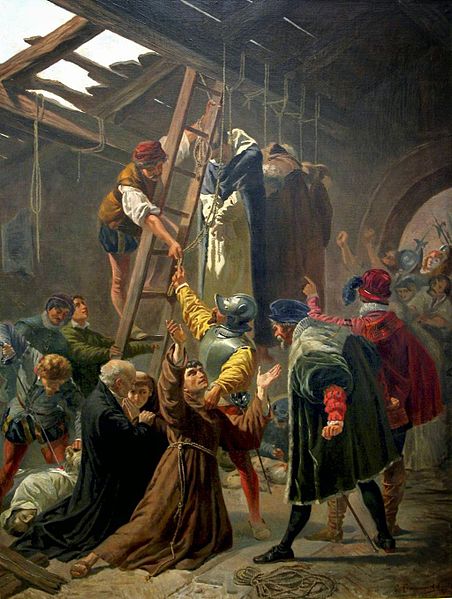
- The Holy Martyrs of Gorinchem or Gorcum or Gorkum or of Brill or Brielle July 9, 1572 in South Holland, in what is now the "Netherlands" Saints Adrian van Hilvarenbeek, Andew Wouters, Anthony van Hoornaar, Anthony van Weert, Cornelius van Wijk, Francis de Roye, Godfried van Duynen, Godfried van Melveren, James or Jacob Lacops, Jerome van Weert, John Lenaerts, John of Cologne, Leonard van Veghel, Nicasius Janssen van Heeze, Nicholas Pieck, Nicholas Poppel, Peter van Assche, Theodore van der Eem, and Willehad van Deem, murdered by the Satanists, Traitors, Apostates, Infidels and Usurpers of the Low Countries, Maranos and Freemasons, for refusing to abandon Christianity and the Pope, refusing to join in the worship of Satan, refusing to submit to the illegal "United Provinces" cleptarchy of the Traitor William of Orange, refusing to deny the Real Presence of Christ in the Eucharist. Canonized June 29, 1867 by Pope Pius IX.
- The Holy Martyrs of Orange St Margaret Mary Anne of the Angels de Rocher, and St Melania, baptized as Marie-Anne-Madeleine de Guilhermier, French Ursuline nuns, murdered by the Satanists, Traitors, Apostates, Infidels of France, Maranos and Freemasons, for refusing to join in the worship of Satan, and for refusing to accept the illegal regime or Cleptarchy of the "Government of Revolutionary France" as "Popes of France" etc., Murdered by them, July 9, 1794 at Orange in the Vaucluse, in France.
- The Seven Holy Martyrs of Pozuelo de Alarcon in the province of Madrid in Spain Francis Polvorinos Gómez, John Anthony Pérez Mayo, John Peter del Cotillo Fenández, Justus González Lorente, Manuel Gutiérrez Martín, Pascual Aláez Medina, and a 7th, murdered at the Casa de Campo Park between Pozuelo de Alarcón and Madrid, July 24, 1936 in Pozuelo de Alarcon in Madrid province of Spain by the Satanists, Traitors, Apostates, Infidels and Usurpers of Spain, Maranos and Freemasons, for refusing to abandon Christianity, refusing to join in the worship of Satan, refusing to submit to the illegal "Republic of Spain government." Pozuelo de Alarcón is a municipality in the Community of Madrid, Spain. Bordering the Moncloa-Aravaca district of Madrid proper to its west, Pozuelo de Alarcón is surrounded by large Mediterranean pine-tree forests: the Casa de Campo, the Monte del Pardo, and the Monte del Pilar.
- The Holy Martyrs of the Baths of Rome St Zeno and Companions, A group of 10,204 Christians enslaved by Diocletian to build the gigantic baths in imperial Rome, Italy, once finished, they were all murdered.
- The Holy Martyrs of Rome Saints Floriana and Faustina, sisters, martyrs at Rome, as recorded in the Martyrology of St Jerome.
- The Holy Martyrs of TaiYuanFu in Shanxi province of China, murdered July 9 1900 by the Boxers, a mix of Chinese pagans and Muslim Infidels, instigated by the Muslim Infidels out of envy over the growing influence of Christianity in China, Saints Andrew Bauer, Elia Facchini, Francis Fogolla, Francis Zhang Rong, Gregory Grassi, James or Jacob Yan Guodong, James or Jacob Zhao Quanxin, John Wang Rui, John Zhang Huan, John Zhang Jingguang, John-Mary Kerguin, Mary Chaira, Mariane Giuliani, Mary Adolphine Dierks, Mary Amandine, Mary de Just, Mary Hermina Grivot, Matthew Feng De, Patrick Dong, Peter Wang Erman, Peter Wu Anbang, Peter Zhang Banniu, Philip Zhang Zhihe, Simon Chen and Thomas Shen Jihe, not yet canonized by a Catholic pope.
- The Holy Martyrs of Thorium or Thora on Lake Velino, now in the diocese of Rieti, Italy Saints Victoria, Anatolia and Audax.
«The two sisters were set for arranged marriages to noble Roman pagans, and were hesitant. Victoria argued that it would be all right as the patriarchs in the Old Testament had been married; but Anatolia cited other examples to prove that for the holiest lives, they should devote themselves to God and stay single. Victoria was convinced, sold her jewelry, gave the money to the poor, and refused to go through with the wedding with Eugenius. The two suitors insisted on the weddings, and the sisters refused. The young men denouced the women as Christians during the time of the persecutions of Decius, but obtained authority to imprison them on their own personal estates, in hopes of breaking their faith and changing their minds. The women converted their servants and guards sent to watch them. Anatolia's suitor, Titus Aurelius, soon gave up, and handed her back to the authorities. Eugenius stayed at it for years, alternating between good and harsh treatment of Victoria, but eventually even he gave up, and returned her to the authorities. She was martyred by order of Julian, prefect of the Capitol and count of the temples. Her example so impressed her guard, Audax, that he converted to Christianity and was himself soon after martyred.»
Collectives of Saints that are not Martyrs or Isomartyrs- Four Holy Brothers of Poland, Benedictine monks, Saints Andrew, Barnabas, Benedict and Justus.
Individual saints- St Adrian Fortescue, cousin of Anne Boleyn, Henry VIII's daughter and also her whore, and therefore cousin-uncle of the Bastard Elizabeth Boleyn, "Queen" of England. For refusing to join the Satanists, Traitors, Apostates, Infidels of England, Maranos and Freemasons, in the worship of Satan, and for refusing to accept the "Kings of England" as "Popes of England" etc., he was Murdered by them, July 9, 1539 on Tower Hill, London, England. Cultus Conformatio May 13, 1895 by Pope Leo XIII.
- St Agrippinus, bishop of Autun.
- St Brictius, bishop of Martola, he was tortured under Diocletian but survived, so is considered a confessor.
- St Brocaidh of Emlagh, a nephew of St Patrick.
- St Condmac or Connmach, of Ath-Blair, or Átha-Silain, an Irish saint.
- St Cyril, bishop of Gortyna in Crete, martyred under Decius.
- St Everild, a revert, nun, entering a convent at York with Saints Bega and Wuldreda under the direction of St Wilfrid. Assigned by Wilfrid to lead a large community of nuns at Bishop's Farm which was later called Everildsham in her honour, and is now called Everingham.
- St Felicianus, a martyr in Sicily, his history is lost.
- St Fidelis Chodnacki or Chijnacki, baptized as Jerome Chidnacki, Polish seminarian, murdered July 9, 1942 by the German Nazi Infidels, not yet canonized by a Catholic pope.
- + St Ephrem the Great, also called Ephrem of the Aramaic nation, Ephrem of Edessa or Ephrem of Nisibis, great Doctor of the Faith, Apologist, Polemicist, called the "Harp of the Holy Ghost," he rehearsed all-female choirs to sing his hymns set to Syriac folk tunes in the forum of Edessa as an antidote against the Bardesanesians, who denied the resurrection of the flesh, and who had in the foregoing century spread these errors at Edessa, by songs which the people learned to sing, after living the last ten years of his life as an exile from his native Nisibis, that had been conquered by the Persians and ceded to them by the Roman Empire, Ephrem, in his sixties, succumbed to the plague as he ministered to its victims, died June 9, 373 AD at Edessa, according to Latin consensus, his liturgical feast is June 18, however, St Bede and St Alban Butler have his Dies Natalis on July 9 (See https://www.bartleby.com/210/7/091.html), on October 5, 1920 AD, Pope Benedict XV proclaimed Ephrem a Doctor of the Church.
- St Hérombert, appointed by St Charlemagne as missionary bishop to the conquered and pacified Saxons, he settled his see at Minden in Westphalia.
- St Jane Scopelli, from an early age, Jane felt drawn to religious life. Her family opposed the vocation, and she obeyed them, living a pious, austere life in her parents' home. On their deaths she founded the Our Lady of the People Carmelite Priory at Reggio, Italy, and served as its first prioress. She refused all endowments or gifts to the convent unless they were given as alms with no strings or conditions attached. Wonderworker. Like with St Anthony of Lisbon / Padua, Our Lord appeared in her arms as a child. Cultus conformatio 1771 by Pope Pius VI.
- St Joachim Hao Kaizhi Ho, nicknamed Yajin, was born in 1782 in the village of Zhazuo or Tchao-Tso in the Xiuwen district of Guizhou province in China into a pagan family. As a young man, he first tried to earn a living by shaking cotton, but later became a coppersmith. In 1802 he met Zhang Dapeng, and from him he heard about the teachings of Christ. After his father died, he and his mother moved to the provincial capital, Guiyang. There he was baptized with the name Joachim by Fr. JohnTang, and he also married a Catholic. But a few years later, his wife died, and he lived in celibacy for the rest of his life. He was a righteous man, hardworking and generous to the poor. He lived a rather ascetic life, prayed continuously and fasted often. He renounced his house for worship, and for his many virtues he was called a living saint. When a great persecution began in 1814, Joakim and about 200 other Christians were thrown into prison. They were told to step on crucifixes, but all refused. The furious judge then made sure that the forty group leaders were subjected to terrible torture, but they rejoiced that they were found worthy to suffer for Christ. After six months in prison, they were sent to Guiyang, where they were again tortured. He fainted several times, but since he did not want to renounce his faith, he was eventually sent into exile to Yili in Mongolia. There he found many priests and Catholics in exile and was able to attend the Mass often. They even built four churches there for the exiled and the local Christians. In 1821, a Muslim uprising broke out, and Joachim helped the soldiers fight the rebels. The general in the defending army reported this to the emperor. As a reward for his courage, Joachim was allowed to return home, after 18 years in exile. P. Hao from Shanxi or Shansi returned with him and gave him a significant amount of money, but he used the money to buy a place for worship. This became the old North Church in Guiyang. In 1836 he was arrested again and asked to renounce the faith. Once again he refused. The result was that he was subjected to cruel torture in prison, but this only strengthened his faith. When the emperor had confirmed the death sentence, he was executed by suffocation on May 29, 1839, and it was said that a fireball was seen over his head, and when he died, it suddenly went up to heaven. Other sources make it clear that he died on July 9, 1839. Joachim was beatified on May 27, 1900 (the document was dated May 7) by Pope Leo XIII (1878-1903) as one of the group "The Blessed Gabriel John Taurin Dufresse and 12 Companions." The word companions in this context does not mean that they actually accompanied him, but that they suffered martyrdom in China and were blessed with him. He has not yet canonized by a Catholic pope.
- Saint Pontianus also known as Pontian or Ponziano in English and Italian, bishop of Tudertum, now Todi, in the province of Perugia in the region of Umbria in central Italy when the Christian persecution under Emperor Diocletian (284-305) raged at its most violent. He stayed in the city and taught the people, hidden in a cistern known only to Christians. But he was discovered and put on trial by Proconsul Ablavius. Since he was a bishop, the tyrant did not find it necessary to ask him a single question, but ordered him to be skinned alive by tearing the skin from head to toe. He was put in heavy chains and taken to Rome, where in prison he converted Ablavius' son St Cassianus (St Cassian) to Christ and appointed him his successor in Todi. After patiently enduring even more suffering, he went to God on July 9, 302. Cassian was confirmed as the new bishop of Todi by Pope St Marcellinus (296-304), but also suffered martyrdom in 304.
- St Procula, martyr, cephalophore. Daughter and only child of the Count of Rodez, France. She had decided to devote her virginal life to mortification and prayer. But her parents, although Christian believers, arranged a marriage for her with the wealthy landlord Gerald or Geraud. Procula, however, stood her ground. Despite this, a day was set for the wedding. Numerous high-ranking guests were invited. When everything was ready, the bridegroom arrived and the meal was prepared, it was time to wait for the bride. She was not to be found. She had taken advantage of the crowds to sneak out, disguised as a beggar, mixing with the pilgrims on St James' Way. She fled across the mountains to the north, and after a week found a cave near Gannat, about two hundred miles away. The groom received permission from her parents to look for her and, if necessary, to bring her home by force. After a long search, he finally found her trail. That led him to the cave where she was staying. However she did not give in. Finally Gerald lost his temper. A man of his class was not used to being disobeyed. He drew his sword and cut off her head. She picked up her head in her hands and walked with it in the direction of the town of Gannat. When Geraud saw what was happening, he realized that he had made a huge mistake. He fell to his knees before her and begged for forgiveness. She gave it to him. She walked the short distance to Gannat, where she terrified the people. They thought they were dealing with a witch or sorceress. But when they heard the truth, they understood that they had a saint in their midst. She entered the Church of the Holy Cross, where a priest was just saying mass. She knelt at the foot of the altar and offered her head to the priest. He received it with reverence and as an offering to God. This day was a July 9. She was buried in this church. In the mid-17th century, the inhabitants of Rodez came to ask for a relic in order to sanctify her birthplace with her presence. Gannat's relics were lost during the turmoil of the French Revolution . But Rodez returned some of the relics it had previously received. Until the second half of the 19th century, Gannat held a procession around the city on October 12 in honor of the saint. Girls were dressed in a long white robe, held together by a purple belt. The colors referred to Procula's virginity of life and to the nobility of her martyrdom. Moulins celebrates the translation of her relics on September 3, Rodez and Gannat on October 12 and 13.
- St Veronica Giuliani, baptized as Ursula, Claretian nun, Stigmatist, died July 9, 1727 at Citta di Castello, Italy, incorrupt, canonized May 26, 1839 by Pope Gregory XVI.
NO INFORMATION- Brictius of Seez
- Dominic Serrano
- Eusanius of Furci, apparently an artist or painter.
OREMUSMost Holy Mary, Mother of God, and our Mother, and all you Saints, Fathers, Mothers, Brothers, Sisters, Popes, Archbishops, Bishops, Hermits, Monks, Martyrs, Virgins, Champions and Heroes of Jesus Christ, whose feasts is today, named and unnamed, we pray to you for your intercession and guidance, lead us away from error and evil and into the Grace and Love of God, that with your assistance, we may join you in Eternity with the Living God, we make this prayer through Jesus Christ Our Lord, Who Lives and Reigns, in the Unity of the Godhead, with the Father and the Holy Ghost, one God, forever and ever, Amen.Lúcío Mascarenhas.
|

Comments
Post a Comment