Julh 7-acem Sogglem Santam
O Caminho dos Santos: Os Santos e festas da Dia 7 de Julho
Julh 7-acem Sogglem Santam | Todos os Santos de 7 de julho | All Saints of July 7
Page URL: https://ocaminhodossanttos.blogspot.com/2021/07/julh-7-acem-sogglem-santam.html.
Saudações! A Paz de Jesus Cristo esteja com você! Desejo-lhe Boas festas de Nossa Senhora, Mãe dos Cristãos, sob os títulos de Nossa Senhora do Soviore, A Doce Mãe da Floresta do Duque (Hertogenbosch), e dos Santos Cirilo e Metódio!
Happy feasts of Our Lady, Mother of Christians, under the titles of Our Lady of Soviore, The Sweet Mother of Hertogenbosch, and of Saints Cyril and Methodius!
- Are you "Proud to be a Catholic"? https://ocaminhodossanttos.blogspot.com/2021/07/proudtobecatholic.html
- An open challenge on the Alleged Hermeneutics of Continuity. https://ocaminhodossanttos.blogspot.com/2021/07/hermeneuticsofcontinuity.html
MAJOR FEAST: Saints Cyril and Methodius, bishops, who are mentioned on the 9th of March. (RM)
July 7, 740: Our Lady of Soviore in Monterosso by the Sea (Monterosso al Mare) in the region of Cinque Terres (Five Lands) of Liguria
- In the invasions and depradations of the Arian and anti-Christian Lombards led by Rotari in 629, the citizens of the village of Albareto fled to the coast, where they then founded the community of Monterosso by the Sea or Monterosso al Mare. Before abandoning Albareto, the inhabitants concealed a precious statue sculpted in hard wood and painted with bright colours, in the locality of Fontanelle, just below Soviore. This statue was a Pieta, portraying the body of Christ on the lap of his mother Mary after the crucifixion. On July 6, 740, a priest from Monterosso, passing by there, noticed a white dove flying over a small house or a tunnel, depending on the version. The next day, July 7, 740, the priest returned with some workers who dug into the place where the dove flew the day before and found the hidden wooden sculpture. The image was again lost, but it reappeared later in the branches of a chestnut tree and it was there that the first chapel of the Sanctuary was built. The Soviore sanctuary is the oldest Marian sanctuary in Liguria. It has been rebuilt and enlarged several times since. In the year 996 the Emperor Otto III, while on his way to Rome, was a guest in the Sanctuary of Our Lady of Soviore. In 1484 Pope Innocent VIII granted a plenary indulgence for visitors to the shrine. The Sanctuary is about four kilometres from Monterosso and is situated on a plateau overlooking the valley of Levanto to the west and to Vernazza towards the east, in the Ligurian province of La Spezia. It is a part of the famous Cinque Terre National Park and is situated amidst beautiful mountains and forests, and is now part of an extended Pigrimage, called the Way of the Sanctuaries, in Liguria. From east to west, they are: La Spezia, Portovenere, the Sanctuary of Our Lady of Montenero at Montenero near Riomaggiore, the Sanctuary of Our Lady of Health at Manarola, the Sanctuary of the Miraculous Our Lady of Grace in San Bernardino near Corniglia, the Sanctuary of Our Lady of Reggio in Reggio above Vernazza, the Sanctuary of Our Lady of Soviore at Soviore near Monterosso, and Levanto. The Cinque Terre or five towns is a string of five fishing villages perched high on the Italian Riviera in Liguria, which until recently were linked only by mule tracks and accessible only by rail or water. An ancient system of footpaths is still the best way to visit the five villages. The Cinque Terre is noted for its natural and scenic beauty. Over centuries, people have carefully built terraces to cultivate grapes and olives on the rugged, steep landscape right up to the cliffs that overlook the Mediterranean Sea.
July 7, 1380 Our Lady of Hertogenbosch in North Brabant, the Low Countries, also called "of Arras, or of Roermund"
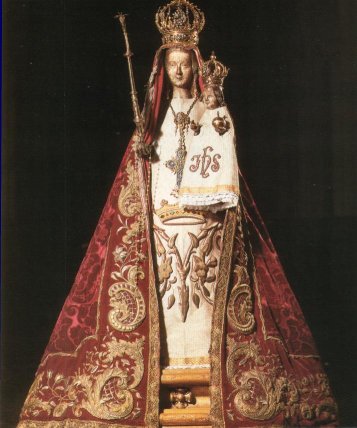 July 7 is marked as the Feast of Our Lady of Arras or of Roermond or of Hertogenbosch, all at Hertogenbosch. Our Lady of the Sands is a shrine in Roermond in the Dutch Limburg, where a shepherd found a statue of Our Lady in a well. It does not seem that today is the feast of Our Lady of the Sands and I am not able to determine what connection Our Lady of Roermond has with Hertogenbosch. The statue of the Kind Mother also called the Sweet Lady of Hertogenbosch seems to be sometimes called Our Lady of Arras with the suggestion that the statue originated in Arras. That history is not recorded, or I cannot find it. What I find is that by 1380, the statue was forgotten and relegated to a corner, and a worker on the Church of St John in Hertogenbosch, finding the statue and seeing that it was abandoned and had grown dirty, was about to use it for firewood. However, his supervisor recognised that it was a statue of Our Lady, rescued it and handed it over the authorities of the church. The statue was cleaned and placed on the Altar of St Martin in the church but initially, it was received unfavourably and with derision. It wasn't long before one of the priests attempted to remove the statue, but found that it had become so heavy he could not move it. It was soon noted, though, that any who spoke disapprovingly of the statue became weak, fainted, or had nightmares. One woman mocked the statue, and became partially paralyzed. That night, she had a vision of Our Lord, who ordered her to repair the statue and honor it. The next day she was able to drag herself to the cathedral to begin the work. At the end of each day she was able to walk a little better. It was an entire year later when a Brother Wout found the missing image of the infant Jesus that went with the statue. Local children were using if for a toy, but now the statue was reunited and whole. There were still some who ridiculed the statue, but now they fainted on the spot. Many experienced strange pains, headaches, and even indigestion. On the other hand, those who prayed before the statue for a cure were healed of their illnesses and otherwise greatly favored. Due to the presence of the statue, the church became a place of pilgrimage. Emperor Maximilian, Holy Roman Emperor, and King Fernando of Castile were among the notables who visited the miraculous statue. The statue of Our Sweet Lady is of oak and is nearly four feet tall and is of an unusual pattern: Our Lady stands upright, while her forearms are extended at right angles to her body. The Child is balanced on her left hand and in her right she holds an apple. In 1566, the Satanists invaded and seized the city of Hertogenbosch, and began to destroy the Christian temples. Chronicles show that from 1380, almost two centuries after the construction of the Saint John in Den Bosch had started, people began to worship the statue of the Virgin and to make pilgrimages to it. In that year the statue of grace was found in one of the construction sheds of St. John's. The construction of the church was still ongoing and it would be many years before it was completed. Experts concluded that the statue must have been made in the early thirteenth century. It probably comes from the first St. John's Church, which was demolished in 1280 to be replaced by a new one. The statue is 1 meter 15 high and is carved from oak. Mary is presented standing up. Mary has an apple in her right hand; She carries the baby Jesus on her left arm. The chapel of the Blessed Virgin in the new St. John soon developed into a place of pilgrimage. The miraculous statue attracted pilgrims from all parts of Europe. Countless miracles take place and Marian worship began to get more and more exuberant. In 1603, Maurice of Orange had appeared with an army for the third time before 's-Hertogenbosch, to take the city, but to no avail. The year 1629 marked an important turning point in the history of 's-Hertogenbosch. The Satanists led by Frederick Henry, a son of the Traitor William the Silent and a half-brother of Maurice, showed up in 1629 with an army of 40,000 men, while 150 ships closed in the city from the Maas side. During the siege, the statue of the Sweet Mother was placed on a throne opposite the pulpit in St. John's Church, and Catholics came to pray daily, led by Michael Ophovius, nicknamed the Fearless. After a siege of four and a half months, the city was forced to surrender to the Satanists on September 14. At the capitulation it was stipulated that the clergy could keep all statues, paintings and ecclesiastical ornaments, but the Satanists did not, not unsuprisingly, keep their word and began destroying St. John's. Then two Carmelites entered the church, seized the statue, and brought it to Bishop Ophovius. He did not consider the statue to be safe in his own home and therefore left it for safekeeping with Anna van Hambroeck. This lady was a pious woman who belonged to one of the principal families of the city. It was therefore believed that she would be spared by the Protestants. Yet Anna did not consider the statue of Mary safe in her home for long, so she decided, on the advice of the bishop, to take it to the Spanish Low Countries. She packed the statue in a large suitcase and, despite the close surveillance, ended up outside the city gate. The journey was not easy, because the Satanists stole three more silver crowns from Our Lady. Nevertheless, Our Lady of Hertogenbosch finally arrived safely with her treasure in Antwerp on one of the last days of 1629. In the meantime, Bishop Ophovius had also been forced to flee to the Spanish Low Countries. Anna van Hambroeck went to visit him in Lier. For many years Ophovius was prior of the Predikheren monastery in Antwerp and confidant of Princess Isabella Clara Eugenia. This Isabella (daughter of the Spanish king Philip II) had heard that the Sweet Lady had fled from Den Bosch to the Spanish Remnant of the Low Countries. Now she sent her secretary De La Faille to the bishop to ask for the statue to be sent to Brussels. After much insistence from the princess, Bishop Ophovius finally gave permission for this, but on the express condition that Brussels would never regard the statue as property and would therefore return it to 's-Hertogenbosch in more favorable circumstances. A notarial deed of this was drawn up, of which a sealed copy kept. It is due to this that the image of the Sweet Mother has not been lost forever to 's-Hertogen-bosch. Also in Brussels the annual Maria celebrations of 's-Hertogenbosch were continued, for which many Catholic residents of Hertogenbosch made pilgrimages. On March 25, 1630, the Sweet Lady was taken to the deanery church of Saint Géry in Koudenberg in Brussels. When Isabella died, the Spanish king Philip IV took over the administration of the Spanish Netherlands. His brother, Cardinal Ferdinand of Austria, had the statue transferred to the church of Koudenberg in Brussels in 1641. In the meantime, Hertogenbosch was seized from the Dutch Satanists by the French Satanists calling themselves "Revolutionary France," and later, the Italian bandit, Napoleon Buonaparte, illegally set up Hertogenbosch as a new bishopry on his own authority, without the permission of the Pope, for which, he took the Church of St John back from the Dutch Satanists and handed it over to the Christians as the Cathedral. However, most of the clergy refused to submit to Matthew Francis van Camp who Bounaparte appointed as his 2nd bishop of Hertogenbosch. After the fall of Buonaparte, Hertogenbosch was included into the new Kingdom of Netherlands and the Dutch Satanists were forced to mitigate their malice against Christianity. From 1840, attempts were made to bring the statue of the Sweet Lady of Hertogenbosch back. The desire to see the Sweet Mother return to her old place became more and more ardent. But Brussels turned out not to be willing to hand over the treasure it had once acquired. It was claimed there that the rights of Den Bosch had become time-barred after such a long period. Then the administration of the diocese of 's-Hertogenbosch came into the hands of Bishop John Zwijsen, a man of steel willpower and perseverance. After his consecration as Bishop of 's-Hertogenbosch and Archbishop of Utrecht in 1853, Mgr. Zwijsen contacted his Mechelen colleague, Cardinal Sterckx. Due to his repeated and persistent efforts, the church council of Koudenberg finally decided in the autumn of 1853 to return the miraculous statue to 's-Hertogenbosch, after a similar statue had been made for the St. Jacob's Church in Brussels. To retrieve the statue, Mgr. John Zwijsen, P.W. van Liempt, Dean of the cathedral, and, John van der Lee, rector of Tilburg, a native of Hertogenbosch travelled to Brussels, returning via Mechelen, where they received the old Miracle Book from the cardinal and placed the statue in the chapel of the mother house of the Sisters of Our Lady of Mercy in Tilburg on December 17, 1853. To the delight of the sisters and others, the Sweet Mother stayed there from 17 to 26 December. In commemoration of this, the Superior General of the Sisters of Our Lady of Mercy in Tilburg donated a golden heart and a cross, which still adorn the statue. On the feast of St John the Evangelist, December 27, Monsignor Zwijsen restored the statue of the Sweet Lady of Hertogenbosch to the Cathedral. A novena was preached by the Redemptorist fathers in the days preceding this feast day, and the joy of the people was exuberant when the Sweet Mother was carried into the centuries-old St. John's Church in a magnificent procession, carried by members of the Brotherhood of Our Lady and accompanied by the guilds of Den Bosch, Elshout and Mariahout. For the time being, the statue was given a place in the present-day Corpus Christi Chapel, until the Sweet Lady on Candlemas, February 2, 1855, was once again returned to her centuries-old throne in the restored Maria Chapel. After an absence of 223 years, the Sweet Mother had returned to her home. On March 27, 1878, the statue was solemnly crowned in the name of Pope Leo III by the bishop of the city, Mgr. Adrianus Gotschalk.
- July 7, 1952: Pope Pius XII in a circular letter, Sacro vergente anno, consecrated the Russian people to the Immaculate Heart of Mary.
- The Translation of the Relics of St Syrius, bishop of Genoa, who had died in the Lord, June 29, 380.
- The Holy Martyrs Saints Alexander and Partinimus, their history is lost.
- The Holy Martyrs of Durazzo or Durres in Albania Saints Peregrinus, Lucianus, Pompeius, Hesychius, Papius, Saturninus, and Germanus, natives of Italy. In the persecution of Trajan, they took refuge in the town of Durazzo, where seeing the saintly bishop Astius hanging on a cross for the faith of Christ, they publicly declared themselves to be Christians, when, by order of the governor, they were arrested and drowned at sea by being loaded with chains and thrown overboard in about 117.
- The Holy Martyrs of Hengyang Saints Anthony "Antoninus" Fantosati, missionary bishop in China, and Joseph Mary Gambaro, murdered by the Boxer pagans instigated by the Muslim Infidels jealous of the growing influence and spread of Christianity in China, July 7, 1900 on the banks of the Xiang River, at Hengyang city (https://en.wikipedia.org/wiki/Hengyang) in Hengzhou in Hunan province of China. They were beatified on November 24, 1946 as one of the group "St Gregory Grassi and 28 companions" by Pope Pius XII (1939-58). Not yet canonized by a Catholic Pope. Some reports falsely give the date of their martyrdom as July 4.
- The Holy Martyrs of Hujiache St Mary Guo Lizhi, captured, tortured and martyred with seven members of her family by the Boxers, instigated and helped by the Muslim Infidels jealous of the growing influence and spread of Christianity in China, she spent her time in prison encouraging the others to keep their faith. Martyred, murdered July 7, 1900 in Hujiache, Shenzhou, in Hebei province of China. Not yet canonized by a Catholic Pope.
- The Holy Martyrs of Rome Saints Claudius, notary, Nicostratus, assistant prefect, Castorius, Victorinus, and Symphorian, who were brought to the faith of Christ by St Sebastian, and baptized by the priest St Polycarp. Whilst they were engaged in searching for the bodies of the holy martyrs, the judge Fabianus had them arrested, and for ten days he tried by threats and caresses to shake their constancy, but being utterly unable to succeed, he ordered them to be thrice tortured, and then drowned in the sea.
- The Holy Martyrs of Winchester Saints Ralph or Randolph or Rudolf Milner, Poor, uneducated but pious farmer, husband and father of eight children in 16th century England. Raised an Anglican, he reverted to Christianity. He was arrested on the day of his First Communion for the "crime" of Reverting. He was such a model prisoner that the jailers gave him keys so he could go out to work and return to serve his sentence. He used this as a way to get priests, including St Roger Dicconson, into the jail to minister to his fellow Christian prisoners. He was offered a reprieve if he would renounce Christianity and worship Satan which he declined. They brought his children to the jail in hopes of changing his mind; he gave them a father‘s blessing, and continued his preparation for execution. Martyred, murdered by the Satanists, Traitors, Apostates, Infidels and Usurpers of England, Maranos and Freemasons, for refusing to abandon Christianity, refusing to join in the worship of Satan, refusing to accept Elizabeth Boleyn, "Queen of England" as the "Pope of England," July 7, 1591 at the Barditch in Winchester, Hampshire, England. With him was murdered St Roger Dicconson or Dickenson, priest, July 7 1591 also in Winchester, England. At some date in 1591, probably the same date, July 7, but that is not certain, was also murdered St Laurance or Lawrence Humphrey or Humphreys, Raised in a Protestant family, Laurence was known to be a studious and pious boy, spending his time with the Bible and other religious works. At the age of 18 he began arguing the faith with a local priest, Father Stanney, and soon wound up Reverting to Christianity. He continued his studies, and spent his spare time visiting prisoners and the sick, teaching and catechizing. In 1591, while delirious with a high fever and talking to himself, he called Elizabeth Boleyn a heretic and a harlot. He was overheard by some local Protestants, and while still sick, Laurance was jailed in Winchester, England for treason. At trial he swore that he did not remember speaking ill of the queen, but would not call his accusers liars, admitted openly and proudly of being a Christian, and so was martyred, murdered.
- Martyrs of the Battle of Zetjun July 6–7, 1614, victory of the Christians against the Satanists, the Muslim Infidels attempting to invade Malta.
- St Angelelmus, monk, abbot of the monastery of Saints Gervase & Protase in Auxerre, and later, bishop of Auxerre.
- St Apollonius, 2nd century bishop of Brescia, Italy. Baptized St Afra of Brescia. The Acts of Saints Faustinus & Jovita say that Apollonius was the bishop who ordained them.
- Pope St Benedict XI, martyr by poisoning by agents of the Satanists William of Nogaret, descendant of Albigensian heretics and who worked to destroy the Christian religion in revenge, and who was involved in the attempted murder, and the resultant death of Pope St Boniface VIII.
- St Bodard, a hermit at Poitiers, died sometime in 740 in or near Poitiers. Today is the Translation of his relics in the ninth century from Poitiers to the monastery of Hornbach near Zweibrücken. His cult spread from there all the way to Mainz.
- St Boisil, also called Boswell, of Melrose, was a monk of Melrose Abbey, an offshoot of Lindisfarne, then in the Anglo-Saxon Kingdom of Northumbria, but now in Scotland. Died in the Lord, July 7, 664.
- St Bonitus, abbot of Monte Cassino when the invading Lombards plundered and destroyed the monastery.
- St Carissima, when she became a widow, she founded the abbey of St Martin in Rauzeille near Aubusson, Creuse, Gaul.
- St Crone of Templecrone, Irishwoman.
- St Emillian or Millán Garde Serrano, priest, martyred, murdered July 7, 1938 in Cuenca, Spain, by the Satanists, Traitors, Apostates, Infidels and Usurpers of Spain, Maranos and Freemasons, for refusing to abandon Christianity, refusing to join in the worship of Satan, refusing to submit to the illegal "Republic of Spain government," not yet canonized by a Catholic pope.
- St Eoaldus, 42nd bishop of Vienne, of royal descent. It was he who consecrated the cathedral of Vienne to the martyrs of the Theban Legion, who are so famous in that part of France. He died in 716. Like all the first 45 bishops of Vienne, including St Wilicarius (d. 765), he is considered a saint. His memorial day is July 7th.
- St Ethelburga or Edelburga, daughter of the King of the East Angles now in England, a nun and then abbess at Faremoutier in France, died July 7, 664, Incorrupt.
- St Felix, bishop of Nantes, see https://www.bartleby.com/210/7/075.html.
- St Hedda, Benedictine monk, then abbot of Whitby in Yorkshire, England. Bishop of Wessex in 676; he served for almost 40 years. Established his see at Dorchester, then Winchester. Adviser to King Ina.
- St Illidius, bishop of Clermont in Auvergne.
- St Illtud or Illtyd, Iltut, Illtut, abbot of Llanilltyd Fawr or Llantwit Major in Glamorgan.
- St Iphigénia of St Matthew, baptized as sMarie-Gabrielle-Françoise-Suzanne de Gaillard de la Valdène, murdered July 7, 1794, by the Satanists, Traitors, Apostates, Infidels and Usurpers of France, Maranos and Freemasons, for refusing to abandon Christianity, refusing to join in the worship of Satan, refusing to accept the Cleptarchy as the "Popes of France." Her liturgical feast in common for the group as the "Martyrs of Orange" is July 9.
- St Joseph Juge de Saint-Martin, Sulpician priest. One of the Martyrs of the Hulks of Rochefort. Martyred, murdered, by the the Satanists, Traitors, Apostates, Infidels and Usurpers of France, Maranos and Freemasons, for refusing to abandon Christianity, refusing to join in the worship of Satan, refusing to accept the Cleptarchy as the "Popes of France."
- St Maelruan, also called Maolruain, Melruan and Molruan, founder-abbot of Tamalcht or Tallaght Abbey in the County of Dublin, Ireland in 769 on land given by Donnchadh, King of Leinster. Together with St Aengus, he helped organize the ascetic movement of the Culdees, died July 7, 791.
- St Mark Ji Tianxiang murdered by the pagans in the Boxer Rebellion, which was instigated and helped by the Muslim Infidels jealous of the growing influence and spread of Christianity in China, beheaded on July 7, 1900 in Yazhuangtou, Jizhou, in Hebei province of China. Not yet canonized by a Catholic Pope.
- St Mary del Consuelo Ramiñán Carracedo, nun, martyred, murdered July 7, 1936 in Madrid, Spain, by the Satanists, Traitors, Apostates, Infidels and Usurpers of Spain, Maranos and Freemasons, for refusing to abandon Christianity, refusing to worship Satan, refusing to submit to the illegal "Republic of Spain government," not yet canonized by a Catholic pope.
- Saints Medran and Odran, Irish brothers, students of St Kieran of Saghir. Odran became abbot of the monastery of Muskerry in Ireland.
- St Merryn, venerated in the country and nation of Cornwall to the south-west of England, his history is lost.
- St Oddin Barrotti, priest and Franciscan tertiary at St John the Baptist Church in Fossano, Italy. Eventually resigned his parish and turned his house into a hospital. In 1396 he agreed to serve as director of the collegiate chapter in Fossano. Died while working with the sick during a plague epidemic either July 7 or 21, 1400. Wonderworker, among other things, he raised a dead man back to life.
- St Odot or Ot of Urgell (sometimes called Odó or Dot), died July 7, 1122, was a bishop of Urgell, noted for his care for the poor. He was from the family of the counts of Pallars Sobirà. He is buried in the monastery of St Mary of Gerri. In 1133 his successor canonized him to be a saint, which happened before the Popes reserved the right of canonization to themselves. He is one of the patron saints of the town of La Seu d'Urgell. His feast day is July 7.
- St Odran, see St Medran.
- St Pantaenus the Philosopher, died about 200, was a Greek theologian and a significant figure in the Catechetical School of Alexandria from around AD 180. This school was the earliest catechetical school, and became influential in the development of Christian theology. Pantaenus was a Stoic philosopher teaching in Alexandria. He was a native of Sicily. He converted to the Christian faith, and sought to reconcile his new faith with Greek philosophy. His most famous student, St Clement, who was his successor as head of the Catechetical School, described Pantaenus as "the Sicilian bee." Although no writings by Pantaenus are now extant, his legacy is known by the influence of the Catechetical School on the development of Christian theology, in particular in the early debates on the interpretation of the Bible, the Trinity, and Christology. He was the main supporter of Serapion of Antioch for acting against the influence of Gnosticism. In addition to his work as a teacher, Eusebius of Caesarea reports that Pantaenus was for a time a missionary, traveling as far as India where, according to Eusebius, he found Christian communities using the Gospel of Matthew written in "Hebrew letters," supposedly left them by St Bartholomew the Apostle. He was, through St Clement of Alexandria, a teacher of Origen.
- St Peter Fourier, Canon Regular of the most holy Savior, renowned for virtues and miracles, died today at Gray in Burgundy.
- St Peter To Rot, a native of Rakunai in Papua New Guinea, he was martyred, murdered by the invading Japanese pagans for refusing to apostatize, July 7, 1945, not yet canonized by a Catholic Pope.
- St Prosperus, a lay theologian at in Aquitania in Roman Gaul. By 417 he arrived in Marseilles as a refugee from Aquitaine in the aftermath of the gothic invasions of Gaul. In 429 he was corresponding with Augustine. By 428, he was a layman living with monks at Marseilles, who disagreed with St Augustine's theology of grace and predestination. To strengthen his arguments, Prosper wrote to Augustine, who responded with On the predestination of the Saints and On the gift of perseverance. He became known as "the best disciple of Augustine." Prosper seems to have labelled anyone who disagreed with Augustine "semi-Pelagian," and the list included Saints John Cassian, Hilary of Arles, and Vincent of Lérins. The enemies of St Augustine turned against St Prosper also, publishing fifteen errors which they attributed to the latter, then sixteen propositions supposedly clarifying Augustine's true sentiments, and spread them widely. Prosper with gentleness answered all these writings without acrid reprisals. In 431, the year after Augustine's death, Proper and a friend named Hilary travelled to Rome to ask Pope St Celestine I, who had praised Augustine, to proclaim the truth of his teachings. Prosper was not an cleric. Pope St Leo the Great, when chosen Pope in 440, invited him to Rome, made him his secretary, and employed him in the most important affairs of the Church. It was primarily St Prosper who finally crushed the Pelagian heresy definitively, when it was raising its head in the see of Peter. Its complete overthrow is said to be due to his zeal, learning, and unwearied endeavors. St Proper seems to have died in or after 463.
- St Tey or Teï, 5th century student of St Guénolé at Landévennec abbey in Brittany.
- St Willibald, son of King St Richard of Wessex, brother of Saints Winnebald and Walburga (they had a 3rd brother, also a saint but I forget his name), and relatives, possibly nephew of St Boniface, ordained and consecrated by Boniface October 21, 741 as a regionary bishop to help him in his missionary work, he fixed his see at Eichstatt. Died July 7, 781.
July 7 is marked as the Feast of Our Lady of Arras or of Roermond or of Hertogenbosch, all at Hertogenbosch. Our Lady of the Sands is a shrine in Roermond in the Dutch Limburg, where a shepherd found a statue of Our Lady in a well. It does not seem that today is the feast of Our Lady of the Sands and I am not able to determine what connection Our Lady of Roermond has with Hertogenbosch. The statue of the Kind Mother also called the Sweet Lady of Hertogenbosch seems to be sometimes called Our Lady of Arras with the suggestion that the statue originated in Arras. That history is not recorded, or I cannot find it. What I find is that by 1380, the statue was forgotten and relegated to a corner, and a worker on the Church of St John in Hertogenbosch, finding the statue and seeing that it was abandoned and had grown dirty, was about to use it for firewood. However, his supervisor recognised that it was a statue of Our Lady, rescued it and handed it over the authorities of the church. The statue was cleaned and placed on the Altar of St Martin in the church but initially, it was received unfavourably and with derision. It wasn't long before one of the priests attempted to remove the statue, but found that it had become so heavy he could not move it. It was soon noted, though, that any who spoke disapprovingly of the statue became weak, fainted, or had nightmares. One woman mocked the statue, and became partially paralyzed. That night, she had a vision of Our Lord, who ordered her to repair the statue and honor it. The next day she was able to drag herself to the cathedral to begin the work. At the end of each day she was able to walk a little better. It was an entire year later when a Brother Wout found the missing image of the infant Jesus that went with the statue. Local children were using if for a toy, but now the statue was reunited and whole. There were still some who ridiculed the statue, but now they fainted on the spot. Many experienced strange pains, headaches, and even indigestion. On the other hand, those who prayed before the statue for a cure were healed of their illnesses and otherwise greatly favored. Due to the presence of the statue, the church became a place of pilgrimage. Emperor Maximilian, Holy Roman Emperor, and King Fernando of Castile were among the notables who visited the miraculous statue. The statue of Our Sweet Lady is of oak and is nearly four feet tall and is of an unusual pattern: Our Lady stands upright, while her forearms are extended at right angles to her body. The Child is balanced on her left hand and in her right she holds an apple. In 1566, the Satanists invaded and seized the city of Hertogenbosch, and began to destroy the Christian temples. Chronicles show that from 1380, almost two centuries after the construction of the Saint John in Den Bosch had started, people began to worship the statue of the Virgin and to make pilgrimages to it. In that year the statue of grace was found in one of the construction sheds of St. John's. The construction of the church was still ongoing and it would be many years before it was completed. Experts concluded that the statue must have been made in the early thirteenth century. It probably comes from the first St. John's Church, which was demolished in 1280 to be replaced by a new one. The statue is 1 meter 15 high and is carved from oak. Mary is presented standing up. Mary has an apple in her right hand; She carries the baby Jesus on her left arm. The chapel of the Blessed Virgin in the new St. John soon developed into a place of pilgrimage. The miraculous statue attracted pilgrims from all parts of Europe. Countless miracles take place and Marian worship began to get more and more exuberant. In 1603, Maurice of Orange had appeared with an army for the third time before 's-Hertogenbosch, to take the city, but to no avail. The year 1629 marked an important turning point in the history of 's-Hertogenbosch. The Satanists led by Frederick Henry, a son of the Traitor William the Silent and a half-brother of Maurice, showed up in 1629 with an army of 40,000 men, while 150 ships closed in the city from the Maas side. During the siege, the statue of the Sweet Mother was placed on a throne opposite the pulpit in St. John's Church, and Catholics came to pray daily, led by Michael Ophovius, nicknamed the Fearless. After a siege of four and a half months, the city was forced to surrender to the Satanists on September 14. At the capitulation it was stipulated that the clergy could keep all statues, paintings and ecclesiastical ornaments, but the Satanists did not, not unsuprisingly, keep their word and began destroying St. John's. Then two Carmelites entered the church, seized the statue, and brought it to Bishop Ophovius. He did not consider the statue to be safe in his own home and therefore left it for safekeeping with Anna van Hambroeck. This lady was a pious woman who belonged to one of the principal families of the city. It was therefore believed that she would be spared by the Protestants. Yet Anna did not consider the statue of Mary safe in her home for long, so she decided, on the advice of the bishop, to take it to the Spanish Low Countries. She packed the statue in a large suitcase and, despite the close surveillance, ended up outside the city gate. The journey was not easy, because the Satanists stole three more silver crowns from Our Lady. Nevertheless, Our Lady of Hertogenbosch finally arrived safely with her treasure in Antwerp on one of the last days of 1629. In the meantime, Bishop Ophovius had also been forced to flee to the Spanish Low Countries. Anna van Hambroeck went to visit him in Lier. For many years Ophovius was prior of the Predikheren monastery in Antwerp and confidant of Princess Isabella Clara Eugenia. This Isabella (daughter of the Spanish king Philip II) had heard that the Sweet Lady had fled from Den Bosch to the Spanish Remnant of the Low Countries. Now she sent her secretary De La Faille to the bishop to ask for the statue to be sent to Brussels. After much insistence from the princess, Bishop Ophovius finally gave permission for this, but on the express condition that Brussels would never regard the statue as property and would therefore return it to 's-Hertogenbosch in more favorable circumstances. A notarial deed of this was drawn up, of which a sealed copy kept. It is due to this that the image of the Sweet Mother has not been lost forever to 's-Hertogen-bosch. Also in Brussels the annual Maria celebrations of 's-Hertogenbosch were continued, for which many Catholic residents of Hertogenbosch made pilgrimages. On March 25, 1630, the Sweet Lady was taken to the deanery church of Saint Géry in Koudenberg in Brussels. When Isabella died, the Spanish king Philip IV took over the administration of the Spanish Netherlands. His brother, Cardinal Ferdinand of Austria, had the statue transferred to the church of Koudenberg in Brussels in 1641. In the meantime, Hertogenbosch was seized from the Dutch Satanists by the French Satanists calling themselves "Revolutionary France," and later, the Italian bandit, Napoleon Buonaparte, illegally set up Hertogenbosch as a new bishopry on his own authority, without the permission of the Pope, for which, he took the Church of St John back from the Dutch Satanists and handed it over to the Christians as the Cathedral. However, most of the clergy refused to submit to Matthew Francis van Camp who Bounaparte appointed as his 2nd bishop of Hertogenbosch. After the fall of Buonaparte, Hertogenbosch was included into the new Kingdom of Netherlands and the Dutch Satanists were forced to mitigate their malice against Christianity. From 1840, attempts were made to bring the statue of the Sweet Lady of Hertogenbosch back. The desire to see the Sweet Mother return to her old place became more and more ardent. But Brussels turned out not to be willing to hand over the treasure it had once acquired. It was claimed there that the rights of Den Bosch had become time-barred after such a long period. Then the administration of the diocese of 's-Hertogenbosch came into the hands of Bishop John Zwijsen, a man of steel willpower and perseverance. After his consecration as Bishop of 's-Hertogenbosch and Archbishop of Utrecht in 1853, Mgr. Zwijsen contacted his Mechelen colleague, Cardinal Sterckx. Due to his repeated and persistent efforts, the church council of Koudenberg finally decided in the autumn of 1853 to return the miraculous statue to 's-Hertogenbosch, after a similar statue had been made for the St. Jacob's Church in Brussels. To retrieve the statue, Mgr. John Zwijsen, P.W. van Liempt, Dean of the cathedral, and, John van der Lee, rector of Tilburg, a native of Hertogenbosch travelled to Brussels, returning via Mechelen, where they received the old Miracle Book from the cardinal and placed the statue in the chapel of the mother house of the Sisters of Our Lady of Mercy in Tilburg on December 17, 1853. To the delight of the sisters and others, the Sweet Mother stayed there from 17 to 26 December. In commemoration of this, the Superior General of the Sisters of Our Lady of Mercy in Tilburg donated a golden heart and a cross, which still adorn the statue. On the feast of St John the Evangelist, December 27, Monsignor Zwijsen restored the statue of the Sweet Lady of Hertogenbosch to the Cathedral. A novena was preached by the Redemptorist fathers in the days preceding this feast day, and the joy of the people was exuberant when the Sweet Mother was carried into the centuries-old St. John's Church in a magnificent procession, carried by members of the Brotherhood of Our Lady and accompanied by the guilds of Den Bosch, Elshout and Mariahout. For the time being, the statue was given a place in the present-day Corpus Christi Chapel, until the Sweet Lady on Candlemas, February 2, 1855, was once again returned to her centuries-old throne in the restored Maria Chapel. After an absence of 223 years, the Sweet Mother had returned to her home. On March 27, 1878, the statue was solemnly crowned in the name of Pope Leo III by the bishop of the city, Mgr. Adrianus Gotschalk.
Comments
Post a Comment