Julh-4-acem Sogglem Santam
O Caminho dos Santos: Os Santos e festas da Dia 4 de Julho
Julh 4-acem Sogglem Santam | Todos os Santos de 4 de julho | All Saints of July 4
Saudações! A Paz de Jesus Cristo esteja com você! Desejo-lhe Boãs festas de Nossa Senhora Mãe dos Cristãos sob os títulos de Nossa Senhora da Alegria, e do Milagre de Nossa Senhora dos Milagres de Avinhão, e das festas dos Profetas Santos Oseias e Ageu!
Happy feasts of Our Lady under the titles of Our Lady of Joy, and of the Miracle of Our Lady of Miracles of Avignon, and of the feasts of the Patriarchs Saints Osee and Aggaeus!
July 4: Our Lady of Joy of Liesse or Notre Dame de Liesse.
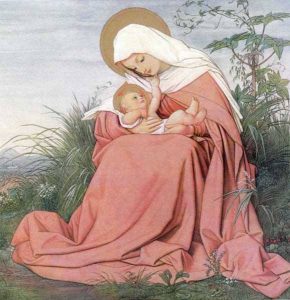 Our Lady of Joy
(not the Original Statue of Notre Dame de Liesse)
«From the hills of Laon where the cathedral lifts its towers adorned with stone-carved oxen in homage to the men who labor below — one can see for miles and miles over the immense plain, to the village of Liesse. In this village of northern France is a shrine dedicated to Our Lady of Joy. Here the village church is naturally everything. The church transports one back to the thirteenth century. Directly in front of the choir screen are four statues. They are the three knights of De Eppes and the Princess Ismoria. Their story is the story of the church. During the time of the Crusades about the year 1134, three knights, brothers from this part of the country, dedicated themselves, heart and soul, to God's cause to fight in Palestine against the Saracens. In a daring raid at Bersake they were taken prisoners and carried off to Egypt. There the Sultan used every means at his disposal to make them apostatize: he starved them, sent his most learned men to discuss with them; but all to no avail. Then he decided to send his beautiful and intelligent daughter, the Princess Ismoria to charm them with her wit. She went to the prison where a discussion was opened, but she was won over by the conviction and constancy of these noblemen, who repeatedly mentioned the Blessed Lady and her Child. Ismoria longed to see a picture or some sort of image of Mary. Couldn't they make her a representation of that Lady? One of the knights, without reflection, promised to do so; but when she brought wood and carving utensils, they realized they could not — none of the knights had ever carved before. What were they going to do? They spent the night in prayer, pleading with Our Lady to do something about it. The next morning they found a luminous statue of the Virgin and Child near the wood to be used. When the princess returned and saw the beautiful refulgent statue, her mind and heart were open to the truth and she no longer doubted the faith of the Christian knights. "If you give me the statue," she cried, "I shall become one of you." The knight gladly gave it to Ismoria, who carried it to the palace. The next night she saw, in a vision, the Virgin who told her to change her name to Mary, to free the imprisoned knights, and to flee with them. The prison was miraculously opened and the four escaped to France; while en route they passed through untold dangers, unchallenged and unseen. On the banks of the Nile they found a young man waiting to take them over the river in his boat. Once across, he suddenly disappeared. Fatigued, they decided to rest before pushing on farther. During their sleep they were miraculously transported to France and the knights awoke to find themselves near their home in Picardy. They went to the castle accompanied by the princess. On the way, Ismoria suddenly found the statue too heavy to carry. They interpreted this as a sign from Heaven that Mary wanted her statue left at this spot. The princess was kindly received by the mother and brothers of the knights and after adequate instruction was baptized by the Bishop of the place. Later, a chapel was built on the spot where the statue had been left. The church took on the name of Our Lady of Joy, because of the wonderful adventures of the three knights and Ismoria. Great the miracles were performed and countless graces obtained through the intercession of Our Lady of Joy, to whose shrine great and humble went St Joan of Arc, Francis I, Louis IX, XIII, XIV, Marie Antoinette, Marie Therese, Blessed Mary of the Incarnation, the pious Olier, John Baptiste de la Salle, Benedict Labre, saints and sinners alike. The original statue was destroyed during the "French Revolution," but the medieval basilica at Liesse remained a center of devotion to the Mother of God, and a new statue was installed and crowned there in 1857. It is still the focus of pilgrimage, especially on Whit Monday.»
Our Lady of Joy (not the Original Statue of Notre Dame de Liesse) |
Our Lady of Miracles at Avignon.
- The shrine was built on the orders of Pope John XXII in the 14th century, to celebrate a miracle, "on the occasion of two criminals being condemned to the fire, one who had invoked the Blessed Virgin was spared by the flames, while the other was entirely consumed." (Richard of Cluny, Life of Pope John XXII.)
The Feast of Our Lady, Refuge of Sinners, Refugium Peccatorum, Nuestra Señora del Refugio de Pecadores in Castilian ("Spanish")
- This feast date is August 13. However, in Nueva Espana, "Mexico," including North or Alta California stolen by Gringostan, it is July 4.
Are you "Proud to be a Catholic"? https://ocaminhodossanttos.blogspot.com/2021/07/proudtobecatholic.html
An open challenge on the Alleged Hermeneutics of Continuity. https://ocaminhodossanttos.blogspot.com/2021/07/hermeneuticsofcontinuity.html
 Present statue of Our Lady of Joy enshrined at Liesse. |
- MAJOR FEAST: Saints Osee (Heretics call him "Hosea") and Aggaeus (Heretics call him "Haggai"), prophets of Old Testament.
- The Translation of the Relics of St Martin of Tours, bishop and confessor, and the Dedication of his Basilica, which took place on the anniversary of his elevation to the episcopate some years previous.
- The Holy Martyrs of Chiusi in Tuscany Saints Irenaeus and Mustiola, July 4th, 273.
- The Holy Martyrs of Cyrene in Cyrenaica, Saints Theodore, bishop of Ptolemais in Cyrenaica, a city near Cyrene, and Companions, Saints Cyprilla, Aroa ("Heiroa") & Lucia, and others, all arrested & executed for being baptized by Theodore; also, St Lucius the Counsellor; Theodore's son, Leontius, betrayed him to the prefect ("governor") Dignianus (var. Diognianus), telling him how many idolaters were turning to Christianity as a result of Theodore's writings. Theodore was brought before Dignianus with a group of Christians following him, including the holy women Cyprilla, Aroa and Lucia. Cyprilla was also a natve, and had been married two years when her husband died, leaving her a widow for twenty-eight years. When these Christians appeared before Dignianus, he not only demanded the sacred books, but bid that the bishop disavow Christ. The holy man did neither. For this he was harshly thrashed with rods and stripes with lead embedded at the ends. He was also processioned twice through Ptolemais so that the pagans could inflict indignities upon him. Afterwards, he was taken to Cyrene to be tried before the tribunal. When he was forcibly taken, by command of the tribunal, to offer sacrifice to the idols, the holy martyr kicked the platform for the sacrifices, hurling it down headlong, and spat on it. Maddened, the pagans hoisted him aloft upon wood and lacerated his entire body. Then they rubbed his wounds with hair cloths doused with vinegar and salt. As he kept on bearing witness to Jesus Christ, they severed his tongue with a razor. However, those three godly women laid hold of that treasured tongue. In the meantime, Cyprilla was sorely afflicted by a pain in her head. She besought her parents to give her leave to hasten to the prison of the venerable Theodore, believing that she could receive healing from Christ's athlete. With Aroa and Lucia she visited Bishop Theodore in prison, and having been cured of her malady through his prayers, they remained and served the holy bishop. As mentioned earlier, these holy women had taken up the bishop's severed tongue. Hence, they delivered the sacred organ to the bishop, laying it upon his chest. Then a dove appeared above him, as well as a peacock which ascended to the window of the cell. The pagan Lucius, who was the chief counsellor of Cyrene, counsellor to the prefect of Cyrene, his Assessor, and also in-charge of the prison, heard a disturbance, and came to inspect the prison. He found Theodore healed, made whole, and sitting up, and conversing with the dove, and was struck with fear, repented, embraced & kissed Theodore, asked for forgiveness and baptism, which Theodore administered to him. Theodore then took leave of the Christians surrounding him in prison, and surrendered his soul into the hands of God. The dove then saluted him and flew from the prison. With the blessed repose of the holy bishop, Cyprilla was reported to the governor. Refusing to sacrifice to the idols, the pagans laid lit charcoals upon one of her hands. After placing incense upon the coals, they forced her to offer a sacrifice of incense to the idols. The holy Cyprilla replied, "This is not a freewill sacrifice of mine, but satanic and involuntary." Indeed, this was the truth, because the executioners applied much strength to hold her hand until it was entirely burned. As her hand burned, she fiercely clutched the burning coals so that they not fall from her hands as a sign of offering to the demons. Afterwards they took the holy woman and raised her aloft upon wood, and shred her flesh. Blood spilled forth from her injuries, milk flowed from her wounded breasts; unable to bear the torments, Cyprilla surrendered her holy soul to Christ, from Whom she received an unfading crown. Lucia & Aroa took up her relics according to the command of the governor, and buried it as they chanted melodious hymns. Not much time passed when the tomb of St Cyprilla proved to be a well-spring of healing for every kind of sickness. In turn, the holy women Lucia & Aroa were beheaded by Dignianus, and went to Paradise. With the deaths of these three holy women, Dignianus soon learned of the conversion of Lucius. Indeed, any other pagans who had come to believe in Christ and were baptized by Theodore were also sentenced to death. However, after Lucius was baptized, he began to teach Dignianus, and finally brought him to acknowledge Christ as true God, and to be baptized himself. Whereupon, the two men boarded a ship and set sail for Cyprus. In Cyprus, the men encountered another prefect who took vengeance upon all those that invoked the name of Christ. Lucius, without Dignianus' knowledge, publicly acknowledged Jesus Christ, and was seized with other Christians, and tortured, to make them revert to the demons. He was beheaded when, with his foot, he cast down the platform of the demons. Dignianus, however, had him wrapped in linen and buried surrounded by perfumes. When his grave was later opened, three roses were seen sprouting from his chest, but they immediately disappeared again when some people tried to pick them in order to regain their health. Lucius received special veneration in Constantinople. He is celebrated August 20, 21, & 22. The Passion of Dignianus is not recorded, or I haven't found it yet, however, the Egyptians & Ethiopians, including the Eritrans, who are all Monophysites, celebrate the Martyrs Theodore, Lucius, Dignianus, Cyprilla, Aroa & Lucia together on this date.
- The Holy Martyrs of Dorchester, England Saints John Cornelius, an Irishman who was also called Mohun in the Irish tongue, priest, Thomas Bosgrave, John or Terence Carey and Patrick Salmon, laymen, murdered July 4, 1597, by the Traitors, Apostates, Infidels and Satanists of England for refusing to accept the "Kings of England" as the "Popes of England." They were offered reprieves if they worshipped Satan, which they refused. There are 2 Dorchesters in England, one in Dorset, the other in Oxfordshire, evidence is that it was the one in Dorset.
- The Holy Martyrs of the Battle of Hattin Saints Raynald de Chatillon, Nicasius and Companions murdered by the Muslim Infidels, July 4, 1187.
- The Holy Martyrs of the Battle of Klushino July 4, 1610, victory of the Christians over the Heretics.
- The Holy Martyrs of Leopolis or Lwow or Lviv in East Poland July 4, 1941 murdered by the German Nazi Infidels aided by the Banderist Ukrainian Nazis.
- The Holy Martyrs of Madaura in Numidia now in Algeria, Saints Namphanion and 27 Companions, Carthaginians, in 180 AD.
- The Holy Martyrs of Sirmium Saints Innocent, Sebastia or Sabbatia and their 30 Companions, their history is lost.
- The Holy Martyrs of York in England Saints William Andleby, priest, and Henry Abbot, Thomas Warcop, and Edward Fulthrop, laymen, murdered July 4, 1597, by the Traitors, Apostates, Infidels and Satanists of England for refusing to accept the "Kings of England" as the "Popes of England." They were offered reprieves if they worshipped Satan, which they refused.
- St Agatha Yun Jeom-Hye martyred by Buddhists July 4, 1801 in Yanggeun, Gyeonggido, Corea (Korea).
- St Albert Quadrelli, bishop of Lodi.
- St Andrew of Crete, bishop of Gortyna.
- St Anthony Daniel, martyred by pagan native Americans of New France.
- St Aurelianus, bishop of Lyons.
- Pope St Benedict V, uncanonically deposed and imprisoned, died in captivity July 4, 965, he prophesized the devastations by the pagan Slavs as Divine punishment until the translation of his remains to Rome.
- St Bernold, monk of Ottobeuren, see St Hatto.
- St Bertha of Artois, abbess of Blangy.
- St Bolcán, or Olcán, abbot of Cill Cuile, now Kilcooley, in Roscommon. He is not the same as Bolcan or Olcan or Volchan of Armoy, a disciple of St. Patrick.
- St Bruno, monk at Ottobeuren, see St Hatto.
- St Carileff of Anille.
- St Catherine Jarrige, not yet canonized by a Catholic Pope.
- St Cesidius James Anthony, Italian missionary in China, murdered by the Boxers, wrapped in a sheet soaked in oil and then burned to death, July 4, 1900 in Hengzhou in Hunan province of China, not yet canonized by a Catholic Pope.
- St Damian Grassi of Rivoli.
- St Dietmar I, or Theotmar I, bishop of Salzburg, martyr, died fighting against the depradations of the then pagan Magyar or Hungarian invaders at Brezlauburg on July 4, 907.
- St Donatus, a bishop in then Christian, Roman Libya.
- St Elias, Patriarch of Jerusalem, exiled to Eilat by the Monophysites.
- St Elizabeth the Peacemaker, Queen of Portugal. Her liturgical festival is celebrated on the 8th of this month, by order of Pope Innocent XII.
- St Finbar, founder-abbot of a monastery on the Innis Doimhle (Isle of Crimlen), Wexford, Ireland in the sixth century.
- St Florentius, bishop of Cahors, France.
- St Flavianus II, bishop of Antioch, exiled to Petra by Emperor Anastasius the Monophysite, where he died.
- St John of Vespignano.
- St Hatto, monk at Ottobeuren in Swabia, in Germany, died July 4, 985. With him are commemorated Saints Bruno and Bernold, also monks at Ottobeuren.
- St Henry, bishop of Albano.
- St Joseph Peter Nguyen Ðình Uyen, martyred in Vietnam, July 4, 1838.
- St Jucundianus, martyred by being drowned at sea, in the province of Roman Africa, now Tunisia.
- St Laurianus, bishop of Seville, martyred by Totila, king of the Arian Ostrogoths, beheaded on July 4, 546 at Bourges, France.
- St Laurianus, martyr at Vistin in Berry, France; possibly same as Laurianus, bishop of Seville, as Bourges is the capital of the French province of Berry.
- St Natalia of Toulouse.
- St Oda the Good, bishop of Worchester and then of Canterbury, in England.
- St Odolric, bishop of Lyon, martyred by wicked Christians.
- St Peter Romero Espejo, Redemptorist priest in the diocese of Cuenca, Spain. Martyred by the Traitors, Apostates, Infidels and Satanists of Spain, July 4, 1938 in Cuenca, Spain. Not yet canonized by a Catholic pope.
- St Peter Kibe Kasui, Japanese Jesuit priest, martyr, murdered by the Buddhists, July 4, 1639, at Tokyo, Japan.
- St Theodotus, a bishop in then Christian, Roman Libya.
- St Ulric or Uldaric, bishop of Augsburg, wonderworker.
- St Ulric, bishop of Ratzeburg in Polabia.
- St Valentinus, hermit at Langres.
- St Valentinus of Paris.
- St William, abbot of Hirsau.
- Maria Salomea Skłodowska Curie, Polish-French scientist.
- Peter George Frassati, died July 4, 1925.
- John Frith, July 4, 1533.
- Narendranath Datta, alias "Swami Vivekananda," July 4, 1902.

Comments
Post a Comment