Julh-15-acem Sogglem Santam.
Santancem Vatt: Julh 15-cem Sogglem Santam. (Concannim).
O Caminho dos Santos: Os Santos e festas da Dia 15 de Julho. (Portugej).The Way of the Saints: All Saints of July 15. (Waspish).
Page URL: https://ocaminhodossanttos.blogspot.com/2021/07/julh-15-acem-sogglem-santam.html.
Saudações! A Paz de Jesus Cristo esteja com você! Boas festas de Nossa Senhora, nossa Mãe Maria, sob os títulos de Nossa Senhora de Molano, e também as festas do Divisão dos apóstolos, a Vitória Polaco-Lituana na Batalha de Grunwald, Santos Bernardo, Tiago de Nisibis, Miguel, Regiswinda e Terêncio!
Happy feasts of Our Lady, our Mother Mary, under the titles of Our Lady of Molanus, and also the feasts of the Divisio Apostolorum, the Polish-Lithuanian Victory at the Battle of Grunwald, Saints Bernard, James, Michael, Regiswinde and Terrence!
- July 15, 1099, Our Lady of Molanus, Jerusalem.
«In the year 1099, the Christian armies arrived at Jerusalem, overjoyed that they had survived to reach their objective. Their joy turned nearly to despair, however, as they ran short of food and suffered greatly with a plague during the siege of the city. The leaders of the crusade concluded that they could not win without courting the Divine Assistance. It was agreed by all that they should march together barefoot around the city while singing litanies to the Blessed Virgin Mary. This they did, as the Jews had done centuries before at Jericho, while praying, fasting, and giving alms. Eight days later Godfrey of Bouillon was the first to breach the walls and set foot in Jerusalem, which was then swiftly taken. The Muslim Infidels were finally defeated after what had been a long and difficult siege, and the First Crusade ended with a Christian victory. Now that the city was in Christian hands, the Crusaders desired that they should have a king for the new Kingdom of Jerusalem. The nobleman Raymond of Saint Gilles was offered the crown, but he refused, as it did not seem proper to him to be named king in that holy place. Next, Robert Courte-Heuse also refused. Finally, Godfrey of Bouillon, who had so distinguished himself in the taking of Jerusalem, was asked to accept the crown. Godfrey of Bouillon was a good man, the son of St Ida of Bouillon, whose father was the Duke Godfrey of Lorraine, himself a descendent of Emperor St Charlemagne. Although Godfrey agreed to be made king, still, as they were about to crown him King of Jerusalem, Godfrey pushed aside the crown, saying, “I cannot wear a diadem in the place where my Lord wore a crown of thorns.” Instead, as he had prayed at Our Lady at Boulogne on the Sea before leaving on the Crusade, he credited the Blessed Virgin Mary with the victory, and symbolically gave the crown to Our Lady of Molanus. After the victory, clad in white garments, the crusaders expressed in solemn procession, hymns and prayers, their gratitude to the Mother of God for giving them this singular victory over the enemies of the Church. The annual celebration in remembrance of the victory occurred each July 15th with a Mass offered to Our Lady of Molanus. Formerly the feast of this event was celebrated with a double office and octave.» Our Lady of Molanus
 - July 15: Alleged Mother of God Icon of Akhtyrka or Okhtyrka in Australia.
The alleged Icon of the Mother of God of Akhtyrka in Australia is a copy of the Akhtyrka Icon. This is an Icon that was allegedly revealed by Mother Mary, on July 2, 1739, to Byzantine Heretics of the "Russian Orthodox Church," at a place called Akhtyrka in Russian and Okhtyrka in Ukrainian, a former Polish military outpost, now in Eastern Ukraine. In 1903, it was apparently stolen while being transported in Siberia, and was found and purchased by a Russian in Harbin in Manchuria in the Ming Empire. In 1950, it was taken to Brazil then to San Francisco in Alta California, Azatlan, Nueva Espana de Norte, and then handed over to the ROCOR, the Russian Orthodox Church Outside Russia. The ROCOR then placed it with its bishop of Sydney, Australia. See https://en.wikipedia.org/wiki/Okhtyrka.
True orthodox Catholics must know that God abhors the prayers of heretics and schismatics, as being impious, and does not have a part with them. As such, Catholics cannot have any part to do with the alleged Mother of God Icon of Akhtyrka / Okhtyrka, on the pain of Mortal Sin.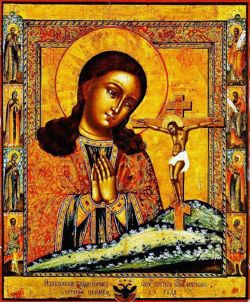 Alleged Mother of God Icon of Akhtyrka or Okhtyrka
 - MAJOR FEAST: Divisio Apostolorum, the Apostles Divide the World into their respective spheres of missionary activities, and disperse.
- MAJOR FEAST: At Palermo, the finding of the body of St Rosalia, virgin of Palermo. Being miraculously discovered in the time of Pope Urban VIII, it delivered Sicily from the plague in the year of the Jubilee.
- July 15, 1099: First Crusade: Christian soldiers liberate the Church of the Holy Sepulchre in Jerusalem from the Muslim Infidels after the final assault of a difficult siege.
- July 15, 1149: The reconstructed Church of the Holy Sepulchre is consecrated in Jerusalem.
- The Victory of the Allied Kingdoms of Poland and Lithuania over the Teutonic Knights at the Battle of Grunwald (Battle of Zalgiris or First Battle of Tannenberg), July 15, 1410 during the War between the allied states of Poland and Lithuania and the Teutonic Knights, resistance against the Germanic colonization of Poland.
- The Holy Martyrs of Alexandria in Egypt Saints Narseus, Philip and Zeno, and also 10 children, their names and history, have not survived.
- The Holy Martyrs of Carthage in Roman Africa now Tunisia Saints Adauctus, Catulinus, Felix, Florentius, Fortunantianus, Januarius, Julia, Justa and Septiminus, who were entombed in the church of St Faustus.
- The Holy Martyrs of the Battle of Grunwald also called the Battle of Zalgiris or the First Battle of Tannenberg, July 15, 1410 during the War between the allied states of Poland and Lithuania and the Teutonic Knights, resistance against the Germanic colonization of Poland.
- The Holy Martys of Malpique in the Canary Islands - 40 Spanish, Portugese and French Jesuit missionaries martyred by the accursed and damned French Satanist Jacques de Sores while en route to Brazil on the ship St James. On July 15 1570 he murdered these Saints and threw their bodies into the sea off Tazacorte in the Canary Islands, off La Palma. Crosses on the sea floor still mark the site at Malpique today. They were beatified by Pope Pius IX in 1854. They are Saints Alexius Delgado, Alfonso de Baena, Alvaro Borralho Mendes, Amaro Vaz, Andrew Gonçalves, Anthony Correia, Anthony Fernandes, Anthony Soares, Benedict de Castro, Blase Ribeiro, Diogo de Andrade, Diogo Pires Mimoso, Dominic Fernandes, Fernando Sánchez, Francis Alvares, Francis de Magalhães, Francis Pérez Godoy, Gaspar Alvares, Gonçalo Henriques, Gregory Escribano, Ignatius de Azevedo, John (no listed last name), John Fernandes (2 with same first and last names), John de Mayorga, John de San Martín, John de Zafra, Luís Correia, Luís Rodrigues, Manuel Alvares, Manuel Fernandes, Manuel Pacheco, Manuel Rodrigues, Mark Caldeira, Nicholas Denis, Peter de Fontoura, Peter Nunes, Simon da Costa, Simon Lopes and Stephen Zuraire.
- The Holy Martyrs of Pannonia Saints Agrippinus, Fortunatus, Martialis, Maximus and Secundinus. It is not known where in Pannonia they were martyred and under who - the pagan Romans, the pagan and Arian Teutons or Germans, or others. Their history is lost. Pannonia is the Roman province nearly identical to modern Hungary; its capital was Sirmium, which lies south of Hungary on the border between modern Serbia and Croatia.
- The Holy Martyrs of Porto Romano at the mount of the Tiber on the coast of Latium on the Tyrhennian Sea Saints Bonosa, Eutropius and Zosima, siblings. Their courage in martyrdom, particularly thatof St Bonosa, converted Magnus, a Centurion, and other soldiers, and they were then martyred, their feast is July 8. Both groups of martyrs were interred in the Catacombs of Pontiani. The relics of Bonosa and Magnus were retrieved in 1700 and gifted by the Pope to the Cistercian nunnery in Anagni in eastern Tuscany, but when the Satanist regime of Italy seized and closed the nunnery, their relics were gifted to the Church of St Martin of Tours in Louisville, Kentucky, USA. Porto Romano may be Ostia.
- Martyrs of Ratzeburg in Polabia now Holstein-Schleswig on the German-Danish border Saints Ansuer and Companions July 15, 1066. Ansuer the Benedictine monastery of St George in Ratzeburg, where he was noted for his learning and piety and became abbot while still young. He devoted himself to the conversion of the Slavs and preached the gospel to the pagans still living around Ratzeburg. In 1066, together with about 30 companions, he was stoned by pagan Wends. He begged his executioners to kill him last so that his companions would not apostatize and so that he could comfort them. His body was first interred in the crypt at St George; but when a blind man was restored to sight at the tomb, Bishop Evermond (d. 1178) had the martyrs' remains translated to the cathedral of Ratzeburg. The relics were destroyed by the Deformers. The Martyrs of Ratzeburg were canonized with papal approval by Adalbert, bishop of Bremen. His memorials are a cross near Ratzeburg and a painting in the cathedral there.
- The Holy Martyrs of Rochefort Saints Bartholomew Jarrige de La Morelie de Biars, and Louis Armand Joseph Adam, priests, martyrs, murdered by the Satanists, Traitors, Apostates, Usurpers of France, Maranos and Freemasons, for refusing to worship Satan, refusing to be traitors, refusing to accept the Satanist Usurpers and Frauds as "Popes of France," July 15, 1794 at Rochefort, France. Not yet canonized by a Catholic pope.
- The Holy Martyrs of Sebaste in Armenia St Antiochus, a physician, brother of St Plato of Ancyra, and Companions. Martyred in the persecutions of the governor Hadrian, he was beheaded by St Cyriacus the Executioner, instead of blood, milk flowed from his severed head, seeing the faith of the martyrs, Cyriacus too converted and was also martyred.
- St Donald or Donivald of Ogilvy, Scotsman, and his 9 daughters. Donald, a resident of Ogilvy in Forfarshire, Scotland, formed a religious group with his nine daughters (the "Nine Maidens") on the death of his wife, living as a hermit and hermitesses, later nuns at Abernathy.
- The Sons of Earcan or the MacErcains, of Bruigh-long or Brugh-laogh, Irish saints, their history is lost.
- St Abudimus or Abudemius, martyr under Diocletian for refusing to eat idol-meats.
- St Adelard or Adalard the Younger, a monk at the abbey of Corbie.
- St Andrew Nguyen Kim Thong or Nam Thuong, murdered by the Buddhists, July 15, 1855 near My Tho, Tien Giang, Vietnam, loaded with chains and with a beam on a forced march.
- St Anne Mary Javouhey, died July 15, 1851 at Paris, France, October 15, 1950 by Pope Pius XII.
- St Anthony Beszta-Borowski, Polish priest, martyr, murdered July 15, 1943 at Bielsk Podlaski, Podlaskie, in Poland by the German Nazi Infidels. Not yet canonized by a Catholic pope.
- St Apronia, sister of St Aprus of Toul to whom she made her vows as a consecrated virgin. Died July 15, 420.
- St Athanasius, bishop of Naples. Son of the Duke of Naples, Italy. Bishop of Naples at age 18. He restored the church of St Januarius that had been destroyed by the Muslim Infidels, founded a hospice, and instituted a service for the ransom of captive Christians. Because he fought simony, he was imprisoned by his corrupt nephew Sergius, Duke of Naples; the clergy and lay people of Naples forced his release, but Athanasius was sent into permanent exile in Veroli, Italy. Confessor. Died July 15, 872.
- St Benedict, bishop of Angers in France, died July 15, 820.
- St Bernard II of Baden-Baden, was the second son of Margrave Jacob of Baden and his wife, Catherine of Lorraine. Died in the Lord, July 15, 1458, in Moncalieri, near Turin, while working for the Emperor Frederick III to organize a crusade against the Muslim Infidels who were then beginning once more to infest Central Europe. He was beatified in 1769.
- St Bonaventure, Cardinal and bishop of Albano, confessor and doctor of the Order of Friars Minor, most celebrated for his learning and holiness of life, died in the Lord, July 15, 1274, however, his liturgical feast is set for July 14, at Lyons in France.
- St Catulinus, deacon at Carthage, whose glories were proclaimed by St Augustine in a sermon to his people.
- St Ceslaus Odrowaz, Polish Dominican priest, possibly a relative of St Hyacinth, the Great Polish Apostle of Eastern Europe, preacher, wonderworker, died July 15, 1242. Cultus confirmatio August 27, 1712 by Pope Clement XI.
- St Comman MacDimmai or MacDiomma, Irish saint, no other information is available.
- St David, English missionary bishop, collaborator of St Sigfried, founder-abbot of a monastery at Munkathorp near Vasteras in Sweden, bishop of Vasteras. He was a Cluniac monk sent around 1020 as a missionary to Sweden. He worked evangelizing the still pagan Swedes starting from the South and then in the Central-Eastern Region of the country; he lived in the place where the church of Munkathorp now stands which with its name recalls the monk (munk) who baptized the new converts in the water of a nearby spring. In the ecclesiastical history of Sweden he is remembered as the apostle of Västmanland and the first bishop of Vasteras. He probably died in 1082 and his body was buried in Munkathorp; four centuries later in 1463 it was moved to the cathedral of its bishopric. Unfortunately, as with other relics of Catholic saints, when Lutheranism took over in Sweden, they were taken and buried in the cemetery and its sarcophagus destroyed. His symbol is a glove, because a legend says that once he hung his gloves on a ray of sunshine.
- St Edith of Tamworth, sister of King Athelstan. Married the Viking leader Sihtric of Northumbria at York in 925. Widowed in 926, she became a Benedictine nun and later, abbess, at Polesworth, in Warwickshire, England. She is distinct from St Edith of Wilton, died 987, daughter of King Edgar the Peaceful, her feast is September 16.
- St Egin of Augsburg, was born in Augsburg, now in Bavaria. He was placed in the Camaldolese abbey of Saints Ulric and Afra as a child. He became abbot of the abbey and involved in the many disputes of his era, and was expelled when he supported Pope Callistus II against Emperor Henry V in a dispute. Residing in St Blaise Abbey, he returned to Augsburg in 1106, resuming his office of abbot in 1109. In 1120, Egin fled to Rome because of his opposition to Bishop Hermann, who practiced simony. Returning to Augsburg two years later, he died in Pisa, July 15, 1122.
- St Eternus, bishop of Evreux in Normandy, he was martyred July 21, 670, he was canonized by his successor Aquilinus. The history of his martyrdom was lost due to the devastations caused by the invasions of the pagan Northmen.
- St Everard of Luzy, a duke, he retired to live a solitary live and took on the occupation of a shepherd so that he could live as a hermit.
- St Evette or Edwette, sister of St Demet of Plozevet. The siblings survived a shipwreck and washed up on the beach of Plozèvet in the bay of Audierne at Penhors, Brittany, France. There she became a hermitess. She became the target of fear, harassment and finally violence by local pagans who accused her of being a witch. The local pagan women planned to attack her, using iron forks that were used on the farms to shovel fuel into ovens; the night before their planned attack, all the forks vanished, and the women left Evette alone. Died in the Lord, July 15, 383.
- St Felicissimus of Mosciano, as a young man he became a Benedictine monk at the monastery of San Eutizio near Norcia, Italy, but was soon forced to leave to help support his family, working as a cowherd. He prayed while in the pastures, and gave all that he could to people even poorer than himself. He later settled as a hermit near Pulcano, where he spent time in prayer for the conversion of indifferent Christians. Wonderworker. Beatified by bishop Virgilius Florence.
- St Felix, bishop of Pavia, martyr.
- St Gumbert or Gumarus of Ansbach, founder-abbot of the monastery of Ansbach in Franconia in Bavaria on the land around his villa, died July 15, 790.
- St Haruch, Benedictine monk, abbot and finally bishop of Werden in Germany, died July 15, 830.
- Emperor St Henry II, confessor. July 13 is his birthday in the Lord, at Bamberg. He led a life of perpetual virginity with his wife St Cunegunde, and converted King St Stephen of Hungary, and almost all his people, to the faith of Christ. His liturgical festival is celebrated on July 15. (RM)
- St James or Jacob, first bishop of Nisibis from 309 until his death. A man celebrated for great holiness, miracles and erudition. He was one of those who confessed the faith during the persecution of Galerius Maximian, and afterwards, in the Council of Nicea, condemned the perverse heresy of Arius, by opposing to it the doctrine of consubstantiality. It was also owing to his prayers, and those of St Alexander, that Arius received at Constantinople the condign punishment of his iniquity, the extravasation of his intestines. James ordained St Ephrem the Great as a deacon for the Church of Nisibis, and participated in the Council of Nicaea in 325. Constructed a basilica and theological school at Nisibis. Launched the first known search by Christians for the mountain of Noah's Ark. Died July 15, 338, at Nisibis.
- St Joseph the Studite, bishop of Thessalonica, fought against the Iconoclast heresy, and was exiled, imprisoned and martyred by starvation, July 15, 832.
- St Michael Bernard Marchand, priest of the diocese of Rouen, martyr, murdered at Rochefort by the Criminals, Satanists, Traitors, Apostates and Usurpers of France, Maranos and Freemasons, for refusing to worship Satan, refusing to be traitors, refusing to accept the Satanist Usurpers and Fraud "Government of Revolutionary France" as "Popes of France." Not yet canonized by a Catholic pope.
- St Paisius also called Pishoy or Bishoy, Desert fathers, hermit in the Nitron and Scete Deserts of Egypt, died July 15, 417.
- St Peter Aymillo, Mercedarian priest and bishop.
- St Peter Nguyen Ba Tuan, priest in Vietnam, martyr, murdered by starvation by the Buddhists, July 15, 1838 in Nam Dinh, Vietnam under Minh Mang.
- St Plechelm, a Northumbrian, Benedictine monk and priest. Pilgrim to Rome with Saints Wiro and Otger. He was sent as a regionary missionary bishop to Northumbria, then switched to the West Frisian missions, Apostle of Gelderland. Helped found St Peter's monastery at Roermond near modern Odilienberg on land given them by Pepin of Herstal. Died July 15, 730 while on mission work.
- St Pompilius Mary of St Nicholas, baptized as Dominic Michael John Baptist Pirrotti, a Piarist priest in the Kingdom of Naples. He died in the Lord, July 15, 1766. In 1890 Pope Leo XIII beatified him and on March 19, 1934, Pope Pius XI canonized him.
- St Regiswide or Regiswindis of Lauffen am der Neckar, daughter of Count Ernst and his wife Fridburga, born around 832, was strangled at the age of seven by her nurse and thrown into the Neckar, as she wanted revenge because her brother had been severely reprimanded by the count for neglect in his care of the horses. Three days later, her body was found and buried. Miracles happened at her grave and the bishop of Wurzburg, Humbert (832-842), translated her relics to the church of Lauffen.
- St Roland, Benedictine monk at the Abbey of Chezery, diocese of Belley, France. Chosen abbot the house in 1170. Died July 15, 1200.
- St Ronan MacMagh, Irish saint, no other information is available.
- St Swithin or Swithun, bishop and Patron of Winchester, Confessor. See https://www.bartleby.com/210/7/153.html.
- St Terentius, 6th bishop of Luni, Italy, noted at the time for his charity and care for the poor. Martyred by Arian Lombards for trying to bring them to orthodox Christianity. Murdered in the early 7th century near the river Lavenza in Avenza, Massa Carrara, Italy.
- St Valentina, a Roman martyr, her history has been lost, her relics were found in the Catacombs and gifted to the convent of the Sisters of Charity at Nevers. Today is the day of translation to Nevers.
- King St Vladimir of Rus, Vladimir the Great.
Major feasts
Historical events
Collectives of Martyrs and Iso-Martyrs
Collectives of Saints that are not Martyrs
Individual Saints
OREMUS
Most Holy Mary, Mother of God, and our Mother, and all you Saints, Fathers, Mothers, Brothers, Sisters, Popes, Archbishops, Bishops, Hermits, Monks, Martyrs, Virgins, Champions and Heroes of Jesus Christ, whose feasts is today, named and unnamed, we pray to you for your intercession and guidance, lead us away from error and evil and into the Grace and Love of God, that with your assistance, we may join you in Eternity with the Living God, we make this prayer through Jesus Christ Our Lord, Who Lives and Reigns, in the Unity of the Godhead, with the Father and the Holy Ghost, one God, forever and ever, Amen.Lúcío Mascarenhas.

Comments
Post a Comment