Abril 27, 2021.
Bom dia de Lucio Mascarenhas!
Good morning from Lucio Mascarenhas! https://www.vaticaninexile.com.
O Caminho dos Santos. Todos Santos do Abril 27, 2021.
Santponnacem vhat: Abril Sohtavisacem Sogglem Santam.
The Way of the Saints. All Saints of April 27, 2021.
OREMUS:
✓ SANTA MAE DE DEUS, interceda pela libertação e restauração de sua amada Goa, a Roma do Oriente, e também Bombaim e todo o Concan, a maldição do apóstata MacAulay, e a maldição e praga dos filhos das trevas, os pagãos e infiéis que colonizam Goa desde 1954-1961 (e Bombaim desde 1661). Amem!
✓ HOLY MARY MOTHER OF GOD, intercede for the liberation and restoration of your beloved Goa, the Rome of the East, and also Bombay and the entire Concan, from the curse of the apostate MacAulay, and the curse and plague of the children of darkness, the pagans and infidels who colonize Goa from 1954-1961 (and Bombay since 1661). Amen!
✓FLEE FROM THE FALSE "gods" and cleave yourselves to the Living God, that you be saved!
 Pachapapa, Vicar of Pachamama the Bloodthirsty Demoness |  His Holiness Pope Michael I |
|---|---|
| If the Apostate Liberal Protestant Modernist on the left, the Pachapapa, is your "Pope," you are guaranteed Eternal Damnation; if you do not acknowledge and submit to the man on the right, His Holiness Pope Michael I, Vicar of Christ, you are guaranteed Eternal Damnation. Choose wisely! #RevertToCatholicism, to the orthodox One Holy Catholic and Apostolic Roman Church, under the Catholic Pope, H.H. Michael I, outside of which, there is No Salvation! https://www.vaticaninexile.com/joining_the_true_catholic_church.php. | |
Boas festas de Nossa Senhora
Happy feasts of Our Lady
Marian Feasts
Our Lady of Montserrat, "La Moreneta" or the "Rose of April"
«Our Lady of Montserrat or the Mare de Déu de Montserrat, ("Mother of God of Montserrat") is venerated at the Monastery of Santa Maria de Montserrat on Mount Montserrat in Catalonia, Spain. The hymn to the Virgin of Montserrat, known as "el Virolai" and sung at noon each day by the boys' choir of the Escolania de Montserrat, begins with the words: "Rosa d’abril, Morena de la serra...," or, "Rose of April, dark-skinned lady of the mountain..." Therefore, Our Lady of Montserrat is sometimes also known as the "Rosa d'abril," or the "Rose of April. Her feast is kept on April 27.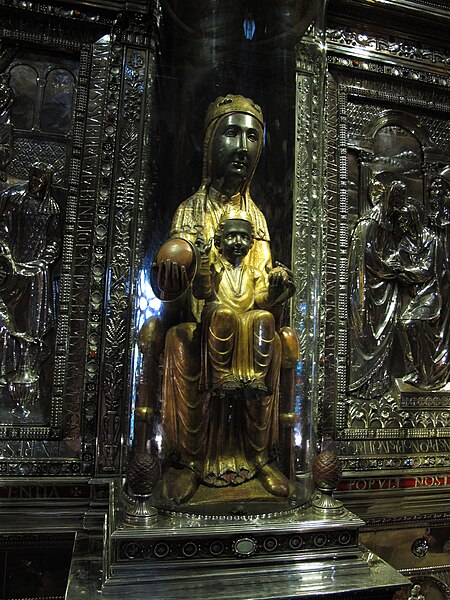 Our Lady of Montserrat
«Our Lady of Montserrat is said to be the "one and only Lady of Spain". She is a black Madonna who reigns from the lofty heights of Montserrat. The Virgin smiles down from her place of honor above the main altar of the Basilica of Montserrat. La Moreneta means the "Little Black One. The statue is four feet high and made of wood, blackened from the smoke of innumerable candles which have burned before her through the ages. She is seated upon a chair and holds her Divine Child who has a fir apple in His left hand. Our Queen is clothed in a golden mantle, a tunic and a veil of diverse colors; the Infant wears a simple tunic, and He and His Mother wear matching wooden crowns. The miraculous statue reposes upon a gleaming throne of marble, and over all, the sunlight diffuses glow.
«The origin of the statue and the manner in which it first came to a lowly grotto in the mountain side is not known, but is told by an uninterrupted folklore describing its descent from heaven. The legends date from the 9th century when it is believed the hermits who dwelt in caves kept watch over a tiny chapel known as Santa Maria de Montserrat. Reliable documents have it that a great monastic center was founded among the same cliffs in the 11th century and that a small black statue of the Madonna drew the kings of Aragon, Castile, Emperor Charles V, saints, and celebrities, as well as common folks to the difficult mountain. Here arduous pilgrimages terminated, and here wondrous miracles were wrought. As the fame of La Moreneta, spread her original chapel underwent many transformations before the basilica was constructed in the 16th century. Now the first chapel is called the "Holy Grotto" and is decorated within with marble, fine tapestries, and two altars; one to St Scholastica, the other to St Benedict so that Mass can be said on feast days and other special occasions.
«Montserrat or the "Saw-tooth Mountain" which Our Lady chose for her shrine is believed to have an intrinsic holiness. Tradition says this is the place the devil took Christ after His forty days' fast; there is possibility of this being true. Montserrat is 4,070 feet high, multicolored and interspersed with lush patches of tropical vegetation.»Notre Dame de Haurt, or, Our Lady of Haurt, also called Our Lady of Bure
See: Chapelle Notre Dame de Haurt.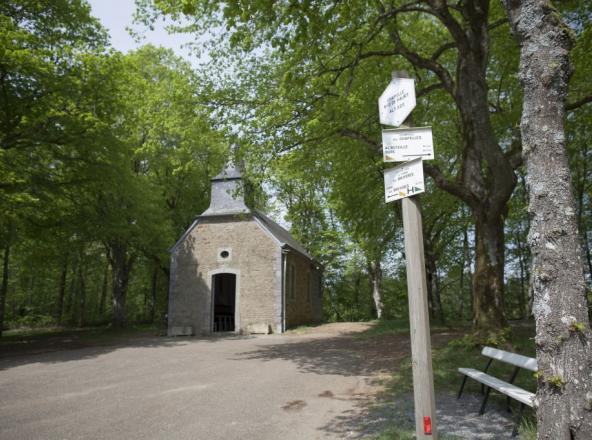 Chapel of Our Lady of Haurt or of Bure
«On the Hill of Haurt just outside the village of Bure, and close to the location of the former village of Nives, in the Ardennes region of the Belgian Hainault, now part of the Belgian Luxembourg, and of Wallonia, stand the small Chappelle de Notre Dame de Haurt or the Chapel of Our Lady of Haurt, also known as Our Lady of Bure. A shepherd from Bure is said to have found a small statue of the Virgin Mary at the location where the Chapel of Our Lady of Haurt or of Bure now stands. The statue was put in the Bure church, but disappeared from the church and quite miraculously found its way back to the Hill of Haurt. The statue was retrieved and put back in the church, but the same thing happened over and over again, until it was quite clear to everyone involved that Our Lady wished to be venerated there and nowhere else!
«A long lane flanked by linden trees and small niches, that represent the Seven Sorrows of the Blessed Virgin, leads to the chapel that was probably built before the 18th century. As is the case with a Stations of the Cross, where the 14 Stations commemorate Jesus's last day on earth, from his condemnation to his crucifixion, the Seven Sorrows of Mary are represented here by the seven crosses. The seven scenes that are depicted here were drawn in 1935 by the comic book author Joseph Gillain, better known under the pseudonym Jijé.»
Your Fiendly Neighbourhood Church, Coventicle of Satan, Demonaria... Poop Charles the Apostate Wojtyla, Vicar of SatanCouncil of Laodicea, 365 AD, "No one shall pray in common with heretics and schismatics." St Cyril of Alexandria, "It is therefore unlawful, and a profanation, and an act the punishment of which is death, to love to associate with unholy heretics, and to unite yourself to their communion." Council of Carthage, "One must neither pray nor sing psalms with heretics, and whoever shall communicate with those who are cut off from the communion of the Church, whether clergy or layman: let him be excommunicated." |
St Zita, by Humbert Benigni, in the Catholic Encyclopedia
«Model and heavenly patroness of domestic servants, born early in the thirteenth century of a poor family at Montsegradi, a little village near Lucca, in Tuscany, died at Lucca, April 27, 1271. A naturally happy disposition and the teaching of a virtuous mother, aided by Divine grace, developed in the child's soul that sweetness and modesty of character and continual and conscientious application to work which constituted her especial virtues. At the age of twelve she entered the service of the Fatinelli family of Lucca. Her piety and the exactitude with which she discharged her domestic duties, in which she regarded herself as serving God rather than man, even supplying the deficiencies of her fellow servants, far from gaining for her their love and esteem and that of her employers rather brought upon her every manner of ill-treatment of both the former and, through their accusations, of the latter. The incessant ill-usage, however, was powerless to deprive her of her inward peace, her love of those who wronged her, and her respect for her employers. By this meek and humble self-restraint she at last succeeded in overcoming the malice of her fellow-servants and her employers, so much so that she was placed in charge of all the affairs of the house.«In her position of command over all the servants she treated all with kindness, not exacting from them any reckoning for the wrongs she had for so many years suffered from them. She was always circumspect, and only severe when there was a question of checking the introduction of vice among the servants. On the other hand, if any of them had been guilty of shortcomings, she took upon herself to excuse or defend them to their employers. Using the ample authority given her by her employers, she was generous in almsgiving, but careful to assist only those really in need. After her death numerous miracles were wrought at her intercession, so that she came to be venerated as a saint in the neighbourhood of Lucca, and the poets Fazio degli Uberti (Dittamonde, III, 6) and Dante (Inferno, XI, 38) both designate the city of Lucca simply as "Santa Zita". The office in her honour was approved by Leo X.
«In 1580 her tomb was discovered in the Church of St Frediano; thus was suggested the solemn approbation of her cult, which was granted by Innocent XII in 1696. The earliest biography of the saint is preserved in an anonymous manuscript belonging to the Fatinelli family which was published at Ferrara in 1688 by Monsignor Fatinelli, "Vita beatf Zitf virginis Lucensis ex vetustissimo codice manuscripto fideliter transumpta". For his fuller "Vita e miracoli di S. Zita vergine lucchese" (Lucca, 1752), Bartolomeo Fiorito has used this and other notices, especially those taken from the process drawn up to prove the immemorial cult.»
The Holy Martyrs of Nicomedia Saints Anthimus and Companions, by St Alban Butler
«The first years of the reign of Dioclesian were tolerably favourable to the Christians, though several even then suffered martyrdom by virtue of former edicts. But Galerius began to persecute them in the provinces within his jurisdiction, by his own authority; and never ceased to stir up Dioclesian to do the like, especially in 302, when he passed the winter with him at Nicomedia. Dioclesian, however, appeared unwilling to come into all his violent measures, foreseeing that so much blood could not be spilt without disturbing the peace of the empire to a high degree. The oracle of Apollo at Miletus was therefore consulted, and gave such an answer as might have been expected from an enemy to the Christian religion. 1 The same author in two places 2 relates another accident which contributed to provoke the emperor against the faith. Whilst Dioclesian was offering victims at Antioch, in 302, in order to consult the entrails for the discovery of future events, certain Christian officers, who stood near his person, "made on their foreheads the immortal sign of the cross." This disturbed the sacrifices and confounded the aruspices, or diviners, who could not find the ordinary marks they looked for in the entrails of the victims, though they offered up many, one after another pretending that the divinity was not yet appeased. But all their sacrifices were to no purpose, for no signs appeared. Upon which the person set over the diviners declared, that their rites did not succeed, because some profane persons, meaning the Christians, had thrust themselves into their assembly. Hereupon Dioclesian, in a rage, commanded that not only those who were present, but all the rest of his courtiers should come and sacrifice to their gods; and ordered those to be scourged who should refuse to do it. He also sent orders to his military officers to require all the soldiers to sacrifice, or, in case of refusal, to be disbanded. Another thing determined Dioclesian to follow these impressions, which one would have imagined should have had a quite contrary effect; it is mentioned by Constantine the Great, who thus speaks in an edict directed to the whole empire, preserved by Eusebius. A report was spread that Apollo out of his dark cavern had declared, that certain just men on earth hindered him from delivering true oracles, and were the cause that he had uttered falsehood. For this reason he let his hair grow, as a token of his sorrow, and lamented this evil among men, having hereby lost his art of divination. Thee I attest, most high God. Thou knowest how I, being then very young, heard the emperor Dioclesian inquiring of his officers who these just men were? when one of his priests made answer, that they were the Christians; which answer moved Dioclesian to draw his bloody sword, not to punish the guilty, but to exterminate the righteous, whose innocence stood confessed by the divinities he adored."
«For beginning this work, choice was made of the festival of the god Terminus, six days before the end of February, that month closing the Roman year before the correction of Julius Cæsar, and when that feast was instituted. By this they implied that an end was to be put to our religion. Early in the morning the prefect, accompanied with some officers and others, went to the church; and having forced open the door, all the books of the scriptures that were there found were burnt, and the spoil that was made on that occasion was divided among all that were present. The two princes, who from a balcony viewed all that was done, (the church which stood upon an eminence being within the prospect of the palace,) were long in debate whether they should order fire to be set to it. But in this Dioclesian’s opinion prevailed, who was afraid that if the church was set on fire, the flames might spread themselves into the other parts of the city; so that a considerable body of the guards were sent thither with mattocks and pickaxes, who in a few hours time levelled that lofty building with the ground.—The next day an edict was published, by which it was commanded that all the churches should be demolished, the scriptures burnt, and the Christians declared incapable of all honours and employments, and that they should be liable to torture, whatever should be their rank and dignity. All actions were to be received against them, while they were put out of the protection of the law, and might not sue either upon injuries done them, or debts owing to them; deprived moreover of their liberties and their right of voting. This edict was not published in other places till a month later. But it had not been long set up, before a certain Christian of quality and eminence in that city, whom some have conjectured to be St George, had the boldness publicly to pull down this edict, out of a zeal which Lactantius justly censures as indiscreet; but which Eusebius, considering his intention, styles divine. He was immediately apprehended, and after having endured the most cruel tortures, was broiled to death on a gridiron, upon a very slow fire. All which he suffered with admirable patience. The first edict was quickly followed by another, enjoining that the bishops should be seized in all places, loaded with chains, and compelled by torments to sacrifice to the idols. St. Anthimus was, in all appearance, taken up on this occasion; and Nicomedia, then the residence of the emperor, was filled with slaughter and desolation.
«But Galerius was not satisfied with the severity of this edict. Wherefore, in order to stir up Dioclesian to still greater rigours, he procured some of his own creatures to set fire to the imperial palace, some parts of which were burnt down; and the Christians, according to the usual perverseness of the heathens, being accused of it, as Galerius desired and expected, this raised a most implacable rage against them: for it was given out, that they had entered into consultation with some of the eunuchs, for the destruction of their princes, and that the two emperors were well nigh burnt alive in their own palace.—Dioclesian, not in the least suspecting the imposture, gave orders that all his domestics and dependents should be cruelly tortured in his presence, to oblige them to confess the supposed guilt; but all to no purpose; for the criminals lay concealed among the domestics of Galerius, none of whose family were put to the torture. A fortnight after the first burning, the palace was set on fire a second time, without any discovery of the author; and Galerius, though in the midst of winter, left Nicomedia the same day, protesting that he went away through fear of being burnt alive by the Christians. The fire was stopped before it had done any great mischief, but it had the effect intended by the author of it: for Dioclesian, ascribing it to the Christians, resolved to keep no measures with them; and his rage and resentment, being now at the highest pitch, he vented them with the utmost cruelty upon the innocent Christians, beginning with his daughter Valeria, married to Galerius, and his own wife, the Empress Prisca, whom, being both Christians, he compelled to sacrifice to idols. The reward of their apostacy was, that after an uninterrupted series of grievous afflictions, they were both publicly beheaded, by the order of Licinius, in 313, when he extirpated the families of Dioclesian and Maximian. Some of the eunuchs who were in the highest credit, and by whose directions the affairs of the palace had been conducted before this edict, having long presided in his courts and councils, were the first victims of his rage: and they bravely suffered the most cruel torments and death for the faith. Among these were SS. Peter, Gorgonius, Dorotheus, Indus, Migdonius, Mardonius, and others. The persecution which began in the palace, fell next on the clergy of Nicomedia. St. Anthimus, the good bishop of that city, was cut off the first, being beheaded for the faith. He was followed by all the priests and inferior ministers of his church, with all those persons that belonged to their families. From the altar the sword was turned against the laity. Judges were appointed in the temples to condemn to death all who refused to sacrifice, and torments till then unheard of were invented. And that no man might have the benefit of the law who was not a heathen, altars were erected in the very courts of justice, and in the public offices, that all might be obliged to offer sacrifice, before they could be admitted to plead. 4 Eusebius adds, that the people were not suffered to buy or sell any thing, to draw water, grind their corn, or transact any business, without first offering up incense to certain idols set up in market places, at the corners of the streets, at the public fountains, &c. But the tortures which were invented, and the courage with which the holy martyrs laid down their lives for Christ, no words can express. Persons of every age and sex were burnt, not singly one by one, but, on account of their numbers, whole companies of them were burnt together, by setting fire round about them: while others, being tied together in great numbers, were cast into the sea. The Roman Martyrology commemorates, on the 27th of April, all who suffered on this occasion at Nicomedia.
««The month following, these edicts were published in the other parts of the empire; and in April, two new ones were added, chiefly regarding the clergy. In the beginning of the year 304, a fourth edict was issued out, commanding all Christians to be put to death who should refuse to renounce their faith. Lactantius describes 5 how much the governors made it their glory to overcome one Christian by all sorts of artifice and cruelty: for the devil by his instruments, sought not so much to destroy the bodies of the servants of God by death, as their souls by sin. Almost the whole empire seemed a deluge of blood, in such abundance did its streams water, or rather drown the provinces. Constantius himself, though a just prince, and a favourer of the Christians, was not able to protect Britain, where he commanded, from the first fury of this storm. The persecutors flattered themselves they had extinguished the Christian name, and boasted as much in public inscriptions, two of which are still extant. But God by this very means increased his church, and the persecutors’ sword fell upon their own heads. Dioclesian, intimidated by the power and threats of this very favourite Galerius, resigned to him the purple at Nicomedia, on the first of April, in 304. Herculeus made the like abdication at Milan. But the persecution was carried on in the East by their successors, ten years longer, till, in 313, Licinius having defeated Maximinus Daia, the nephew and successor of Galerius, joined with Constantine in a league in favour of Christianity. Dioclesian had led a private life in his own country, Dalmatia, near Salone, where now Spalatro stands, in which city stately ruins of his palace are pretended to be shown. When Herculeus exhorted him to reassume the purple, he answered: "If you had seen the herbs, which with my own hands I have planted at Salone, you would not talk to me of empires." But this philosophic temper was only the effect of cowardice and fear. He lived to see his wife and daughter put to death by Licinius, and the Christian religion protected by law, in 313. Having received a threatening letter from Constantine and Licinius, in which he was accused of having favoured Maxentius and Maximinus against them, he put an end to his miserable life by poison, as Victor writes. Lactantius says, that seeing himself despised by the whole world, he was in a perpetual uneasiness, and could neither eat nor sleep. He was heard to sigh and groan continually, and was seen often to weep, and to be tumbling sometimes on his bed, and sometimes on the ground. His colleague Maximinian Herculeus thrice attempted to resume the purple, and even snatched it from his own son, Maxentius, and at length in despair hanged himself, in 310. Miserable also was the end of all their persecuting successors, Maxentius, the son of Herculeus, in the West, and of Galerius and his nephew Maximinus Daia, in the East. No less visible was the hand of God in punishing the authors of the foregoing general persecutions, as is set forth by Lactantius, in a valuable treatise entitled On the Death of the Persecutors.
«Thus, whilst the martyrs gained immortal crowns, and virtue triumphed by the means of malice itself, God usually, even in this world, began to avenge his injured justice in the chastisement of his enemies. Though it is in eternity that the distinction of real happiness and misery will appear. There all men will clearly see that the only advantage in life is to die well: all other things are of very small importance. Prosperity or adversity, honour or disgrace, pleasure or pain, disappear and are lost in eternity. Then will men entirely lose sight of those vicissitudes which here so often alarmed, or so strongly affected them. Worldly greatness and abjection, riches and poverty, health and sickness, will then seem equal, or the same thing. The use which every one has made of all these things will make the only difference. The martyrs having eternity always present to their minds, and placing all their joy and all their glory in the divine will and love, ran cheerfully to their crowns, contemning the blandishments of the world, and regardless even of torments and death.
«Tertullian observes, that it was the glory of the Christian religion that the first emperor who drew his sword against it was Nero, the sworn enemy of all virtue. This tyrant, four years after he had begun, in 64, to exert his rage against the Christians, in his extreme distress attempted to kill himself; but, wanting resolution, he prevailed upon another to help him to take away his life, and perished under the public resentment of the whole empire, and the universal detestation of all mankind, for his execrable cruelties and abominations. Domitian persecuted the church in 95, and was murdered by his own servants the year following. Trajan, Adrian, Titus, Antoninus, and Marcus Aurelius rather tolerated than raised persecutions, and escaped violent deaths. Severus, after he began, in 202, to oppress the Christians, fell into disasters, and died weary of life, leaving behind him a most profligate son, who had attempted to take away the life of his father, and afterwards killed his brother: and his whole family perished miserably. Decius, after a short reign, died in battle. Gallus was killed the year after he commenced persecutor. Valerian was a cruel enemy to the Christians, and died in miserable captivity in Persia. Aurelian was killed in 274. Maximinus I. was slain after a reign of three years. Nothing prospered with Dioclesian after he began his war against the church: out of cowardice he abdicated the empire, and at length put an end to his own life. His colleague, Maximian Herculeus was compelled to hang himself in 310. Maximian Galerius, the most cruel author of Dioclesian’s persecution, was seized with a grievous and terrible disease: for, being extremely fat and unwieldy, his huge mass of flesh was overrun with putrefaction, and swarmed with vermin; and the stench that came from him was not to be borne even by his own servants, as Eusebius relates, (b. 8, c. 16.) Maxentius was overcome by Constantine, and drowned in the Tiber. Maximinus II. after being defeated by Licinius, was compelled by him to repeal his edicts against the Christians, and died in 313, in exquisite torments, under a distemper not unlike that of Galerius—for, whilst his army was drawn up in the field, he was lurking and hiding his cowardly head at home, and flying to Tarsus, not knowing where to find a place of refuge on land or sea, but scared every where with his fears: he was also struck with a sore distemper over his whole body. In the most acute and insufferable anguish, he rolled himself upon the ground, and pined away by long fasting, so that he looked like a withered and dried skeleton. At last, he who had put out the eyes of the Christians, lost his sight, and his eyes started out of his head; and, yet still breathing and confessing his sins, he called upon death to come and release him, which advanced slowly, and not till he had acknowledged that he deserved what he suffered for his cruelty, and for the insults which he had committed against Jesus Christ, as Eusebius relates: (Hist. l. 9, c. 10,) who adds, that all the rulers of provinces, who had acted under him, and persecuted the Christians, were put to death, as Pincentius, his principal favourite, Culcianus, in Egypt, Theotecnus, and others. Urbanus, the cruel governor of Palestine, had been convicted of many crimes at Cæsarea, and condemned to a shameful death by Maximinus himself; and his successor, Firmilianus, had met with the same fate from the hands of his master, whom, by his cruelties, he had studied to please. Licinius, the last of these persecutors, was a worthless and stupid prince, who could not read or write his own name, hated all men of learning, and was a foe to religion. He, to please Constantine, for some time favoured the Christians, and pretended himself ready to become one; but at last threw off the mask, and persecuted the church, when he was conquered and put to death by Constantine, in 323.»
List of Saints Compiled from the Roman Martyrology 1916, St Alban Butler and from other sources
ALSO |
Et alibi aliorum plurimorum sanctorum Martyrum et Confessorum, atque sanctarum Virginum.
R.: Deo gratias.
Pretiosa in conspectu Domini
R.: Mors Sanctorum eius.
Omnes sancti Martyres, et sanctorum:
R.: Orate pro nobis.
The Catholic Church under Peter and his successors is the Bride of the Lamb, preserved by Him spotless and immaculate. Satan has fabricated many Counterfeits of the Lamb's Bride, who are whores of Satan. Any that adheres to these Whores, any who reject the Bride of the Lamb and who will not submit to be part of the Bride of the Lamb, the Mystical Body of Jesus Christ, have no part in Jesus Christ, in Jehovah-Elohim, but are Members of the Whores of the Antichrist, and are assured of Eternal Damnation.Lúcìo Mascarenhas
LUCIO MASCARENHAS confesses the lawful Catholic Vicar of Christ, Pope Michael I, elected 1990, and as found at www.vaticaninexile.com, and holds from the Pope, Plenipotentiary Authority and Apostolic Jurisdiction: to admit souls to the Catholic Church, to reconcile Clerics, to correct and to legitimize marriages (which are invalid among members of #RomanProtestantism) etc.

Comments
Post a Comment