Abril 26, 2021.
Bom dia de Lucio Mascarenhas!
Good morning from Lucio Mascarenhas! https://www.vaticaninexile.com.
O Caminho dos Santos. Todos Santos do Abril 26, 2021.
Santponnacem vhat: Abril Sohvisacem Sogglem Santam.
The Way of the Saints. All Saints of April 26, 2021.
OREMUS:
✓ SANTA MAE DE DEUS, interceda pela libertação e restauração de sua amada Goa, a Roma do Oriente, e também Bombaim e todo o Concan, a maldição do apóstata MacAulay, e a maldição e praga dos filhos das trevas, os pagãos e infiéis que colonizam Goa desde 1954-1961 (e Bombaim desde 1661). Amem!
✓ HOLY MARY MOTHER OF GOD, intercede for the liberation and restoration of your beloved Goa, the Rome of the East, and also Bombay and the entire Concan, from the curse of the apostate MacAulay, and the curse and plague of the children of darkness, the pagans and infidels who colonize Goa from 1954-1961 (and Bombay since 1661). Amen!
✓FLEE FROM THE FALSE "gods" and cleave yourselves to the Living God, that you be saved!
 Pachapapa, Vicar of Pachamama the Bloodthirsty Demoness |  His Holiness Pope Michael I |
|---|---|
| If the Apostate Liberal Protestant Modernist on the left, the Pachapapa, is your "Pope," you are guaranteed Eternal Damnation; if you do not acknowledge and submit to the man on the right, His Holiness Pope Michael I, Vicar of Christ, you are guaranteed Eternal Damnation. Choose wisely! #RevertToCatholicism, to the orthodox One Holy Catholic and Apostolic Roman Church, under the Catholic Pope, H.H. Michael I, outside of which, there is No Salvation! https://www.vaticaninexile.com/joining_the_true_catholic_church.php. | |
Boas festas de Nossa Senhora, Mãe do Bom Conselho, e do Papa São Cleto!
Happy feasts of Our Lady, Mother of Good Counsel, and of Pope St Cletus!
Marian Feasts
April 26: Our Lady, Mother of Good Counsel of Genazzano, Rome
«In the 5th century, during the reign of Pope Sixtus III, the town of Genazzano, about 48 km south of Rome, had contributed a large portion of its revenue for the Roman basilica now known as Santa Maria Maggiore (St Mary Major or St Mary the Great). In appreciation, a church, called Santa Maria, was built in Genazzano, on a hill where previously a Demonarium of Venus had been, and was later entrusted to the Augustinian Order in 1356 AD. The Genazzano church became a popular place of pilgrimage. Numerous cures were said took place there. The Augustinian friars were invited to minister to the spiritual needs of the pilgrims. They continue to serve there to this day.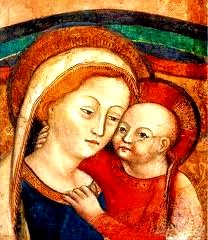 Original Image,
Our Lady of Good Counsel of Genazzano,
near Rome, Italy Original Image,
Our Lady of Good Counsel of Genazzano,
near Rome, Italy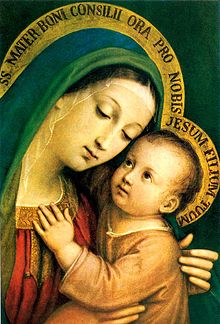 Our Lady of Good Counsel
by Pasquale Sarullo
«In 1467 AD in a small church in Scutari, Albania, there was the old painting of Our Lady with the child Jesus and no one in the village knew where it had came from. King George of Albania, Scanderbeg, Turkish for Prince Alexander, had a great devotion to this image.
«George Castrioti Scanderbeg (1405–1467 AD), also known as Scanderbeg, Turkish for Prince Alexander, or by his more colorful title, the Dragon of Albania. He was a great warrior and leader of the people of Albania who fought against the encroachments of the Muslim Infidels upon his native Albania. An invincible opponent of Islam, the reason for his successes was no secret: he "loved the sanctuary of Mary with a devoted, enthusiastic love; and Mary in return, not only made him a model of Christian perfection, but also gave him an invincible power, which preserved not only Albania but also Christendom during his reign."
«There was at this time a miraculous painting located in the town of Scutari, which was the capital of Albania. Our Lady of Scutari, now known as Our Lady of Good Counsel and Our Lady of Genazzano, is an image of Our Lady holding her Divine Son which had been painted on a thin sheet of plaster by an unknown hand. This portrait, reputed to date from the time of the Apostles of Christ, was greatly venerated and beloved by the faithful Albanian people. It was Our Lady of Scutari who had consoled and preserved Scanderbeg through all his trials.
«After his victories, Scanderbeg went to kneel before the image of Our Lady of Scutari, thanking and publicly praising her for his success. "He was a hero formed in the same school as all those who derive their strength from their devotion to the Blessed Virgin. Like a new King St Fernando III of Castile, Scanderbeg was, under the guidance of Mary, as gentle in peace as he was terrible in war. The good Christian prince was often seen at her feet to beg the protection of his Lady in his greatest afflictions."
«Pope Nicholas V called Scanderbeg "the champion and shield of Christendom," which was true, although it was the Blessed Virgin Mary who protected her champion and granted him his victories. The prince and unvanquished warrior, whose strength of soul gave his compatriots fortitude to throw off their lethargy, courage to rise up against the oppressive infidels, daring to despise death and thus expel them from their country, moved his subjects not only by example but also by his unbreakable faith, his ardent charity, and his unshakable hope. Scanderbeg was God's sword against the enemies of the holy Catholic Faith, the impregnable defensive wall protecting his realm.
«At the end of his life, physically exhausted from his labors, Scanderbeg sensed that his death was near. He went one last time to visit Our Lady of Scutari at her shrine, and then retired to the city of Lesh to die. There he won a final battle against the Turks before he lay down and gave up his soul to God. He had ended his life heroically as a powerful defender of the Catholic faith and of Christendom.
«Shortly after Scanderbeg's death, the Infidels once again infested Albania. Without their invincible champion, it was only a matter of time before the capital was taken. The Blessed Virgin revealed to two pious men, her devotees, George and De Scalvis, that her image would not be desecrated, and told them to prepare themselves for a long journey to follow the fresco when it left Albania. The picture then moved away from the wall, seemingly of its own accord, and floated into the air.
«As the pair followed the image of Jesus and Mary, it was hidden in a cloud and went out over the waters of the Adriatic Sea. Full of confidence in Our Lady, the men stepped upon the water, which miraculously supported them, and so they continued to follow the image until they made land along the coast of Italy.
«Due to the Turk Muslim Infidels invading Albania, many villagers were fleeing. Two young men, George and De Scalvis, often visited the church to pray. They had had a particular devotion to Mary as depicted in the painting of Mary and regretted that it would be left behind. One night as they prayed in the church, they both fell asleep and dreamt that Mary had commanded them to leave the country. She also said that the painting would also depart to escape from the Turks and that they must follow the painting wherever it went.
«In the morning the painting had detached itself from the wall and hovered, wrapped in a white cloud. They followed after as the painting led them to the coast. Then they followed it out across the water, walking over the Adriatic Sea, until they reached the Italian coast. After a few days the cloud and the painting disappeared. George and De Scalvis began searching the area until they found the old Augustinian church of Santa Maria in Genazzano.
«On April 25, 1467 AD, in the midst of the festivities for the Feast of Saint Mark, the townfolk suddenly heard "exquisite music." A mysterious cloud was then said to have descended on the unfinished wall of the parish church. In front of the people, the cloud dissipated and a beautiful fresco, no thicker than a carte-de-visite and no more than eighteen inches square, of the Virgin Mary and the Christ Child was revealed. It was widely believed that it had been miraculously transported from a church in Scutari, Albania.
«The picture of Our Lady was at first called "La Madonna del Paradiso" (Our Lady of Paradise) and now better known as "Madonna del Buon Consiglio" (Our Lady of Good Counsel).
«Such was the holy image's reputation that Pope Urban VIII made a pilgrimage there in 1630 AD, invoking the protection of the Queen of Heaven, as did Pope Pius IX in 1864 AD. On November 17, 1682 AD, Pope Innocent XI had the picture solemnly crowned. Among her noted clients have been St Aloysius Gonzaga, St Alphonsus Liguori, St John Bosco, and St Stephen Bellesini.
«The Augustinian Order, custodians of the church, contributed to the spread of this devotion internationally.
«In 1727 AD, Pope Benedict XIII granted the clergy of Genazzano an Office and Mass of Our Lady for 25 April, the anniversary of the apparition, elsewhere the feast being kept a day later so as not to conflict with that of St Mark the Evangelist. On July 2, 1753 AD Pope Benedict XIV approved the Pious Union of Our Lady of Good Counsel for the faithful at large, and himself enrolled therein as its pioneer member; Pope Pius IX and Pope Leo XIII were both later members. On December 18, 1779 AD, Pope Pius VI, while re-approving devotion to Our Lady, granted all Augustinians an Office with hymns, lessons, prayer and Mass proper of double-major rite, with a plenary indulgence also for the faithful, to which Pope Pius VIII added another for visitors to the shrine. On December 18, 1884 AD, Pope Leo XIII approved of a new Office and Mass of second-class rite for all Augustinians, while on 17 March 1903, he elevated the church of Santa Maria — one of the four parish churches in tiny Genazzano — to the rank of minor basilica.
«On April 22, 1903, Pope Leo XIII included the invocation "Mater boni consilii" in the Litany of Loreto. In 1939, Venerable Pope Pius XII placed his pontificate under the maternal care of Our Lady of Good Counsel and composed a prayer to her.
«The small Scapular of Our Lady of Good Counsel, called the White Scapular, was presented by the Hermits of St Augustine to Pope Leo XIII, who, on December 19-21, 1893, approved it and endowed it with indulgences in a Decree of the Congregation of Rites.
«On the front panel of the sacramental, to be made of white wool, is the image of the fresco of Our Lady of Good Counsel, with the inscription, "Mater boni consilii, ora pro nobis." On the second segment is found the papal coat-of-arms, which includes the Triple Tiara and the Keys of Heaven, with the words of Pope Leo XIII: "Fili acquisce consiliis ejus," "Child, listen to her counsels."»Our Lady of Nájera, La Rioja, Spain
«On April 26, 1044, King García III of Navarre (1035 - 1054 AD), while hunting with falcons, followed his hawk into a cave to discover an image of the Virgin Mary, a bouquet of lilies, a lamp and a bell. The king decided to build a monastery on this site. The image was venerated under the name of María en la Cueva, Our Lady of the Cave, in Nájera. The cave in which it is said to have been found, is included in the church and monastery complex built around the site. The king attributed his victories in the Reconquista (Reconquest) against the Muslim Infidels occupying Spain, to this image. Original image of Our Lady of Nájera
 Image now celebrated in the Church of Our Lady of Nájera
«Nájera, in the vicinity of the ruins of the former Roman city of Tritium Magallum, is a small town, and a former bishopric, the former capital of the Kingdom of Navarre, located in the "Rioja Alta" region of La Rioja, northern Spain, on the river Najerilla.
«Santa María la Real is the monastery in Nájera that includes the Church of the Virgen de la Cueva of Nájera (Our Lady of the Cave).
«The image which originally leads to the construction of the religious complex is a medieval polychrome sculpture carved in wood. It depicts the Virgin holding baby Jesus, imparting blessings with the right hand while holding an orb on the other.
«In the rear part of the central nave is the cave in which King García III of Navarre is said to have found the image of the Virgin Mary in 1044.
«Until the construction of the main reredos, the image of the Virgin was kept in this place. It was later replaced by another coming from the chapel of the Alcázar Real, which is the one that can be seen today since 1845. This carving dates back to the end of the 13th century. The cave has been one of the places chosen by numbers of noblemen and religious leaders for their burial.»Nuestra Señora de las Victorias, Our Lady of Victories, Victorias, Negros Occidental, the Philippines
«During Spanish rule, the city of Victorias was first called Tugkagawan and later Malihaw. The name was taken from Malihaw trees which are in abundance along the banks of the Malihaw river. During Captain Gregory Conlu's term, Moro (Muslim) pirates and Tulisans (former soldiers turned bandits) reigned unmolested. One day the Captain's household was robbed. Captain Gregory was able to escape together with his secretary Alfonso Pachera, but his wife Capitana Tutang and their servant Micay, were taken aboard the pirates' boat which immediately sailed for the open sea. Nuestra Señora de las Victorias, & St Casimir
Victorias, Negros Occidental, Las Philippinas
«When Capitana Tutang was asked whether she knew how to swim, she replied that she could not. She and her servant were then thrown overboard while the vessel was just outside the Malihaw river's mouth. The robbers sailed on believing that Capitana Tutang and her servant were drowned but that was not the case, for Capitana Tutang and her servant were good swimmers.
«While struggling in the water, Capitana Tutang saw an apparition of the Blessed Virgin Mary. When she reached home she prayed and promised to buy an image of the Lady who helped them. But having been divested of her possessions, it took her several months of careful savings to accumulate a sizable sum for the purchase of the image from Barcelona, Spain. Since she did not specify what image she wanted, the Capitana received the statue of the "Nuestra Señora de las Victorias" which to her amazement was that same image of Our Lady who saved them from drowning.
«One year before the expiration of the term of Captain Gregory, in 1880 AD, two boatloads of Moro pirates entered the Malihaw river to attack the Daan Banua (Old Town). At the mouth of the river, the pirates were met by a small banca (horse carriage) riden by a Lady who had a long sword and a very big man with a spear. Upon seeing the two, the Moros sailed back in fright.
«Three months later, four vintas (outriggers) bearing Moro pirates approached the river's mouth to sail inland, but again the same banca with a Lady and a very big man stood guard and the marauders steered away towards the neighbouring town of Manapla, where they took captives. Two of their captives who had been on the pirates' boats when they had attempted to attack Malihaw, were able to escape to Malihaw during the raid on Manapla. These two related their adventure and collaborated the story of the Lady and the very big man in the banca. Upon seeing the images of Nuestra Señora de las Victorias and St Casimir, the reknowned Polish prince who was the first Patron of the City, they recognized them as the man and woman who had terrorized the pirates away from Malihaw. The story which spread like wild fire and reached the ears of the Parish Priest of Saravia, Fr Crispino Hinolan, a Visayan, who immediately went to Malihaw to verify the story.
«After a thorough investigation, the priest declared that the town was saved by the Virgin and St Casimir her companion. The proclamation of the Parish Priest resulted in rejoicing and celebration. Captain Gregorio and Padre Crispino proposed to the inhabitants that the name of the town of Malihaw be changed to "Nuestra Señora de las Victorias" to perpetuate the miracles. The suggestion was at once received with unanimous enthusiasm and acceptance and the citizens enjoined the Captain to ask the Governor to approve the change of name, which the Governor gave. Later, the name came to be abbreviated to "Victorias" as the official name.
«The citizens of the city of Victorias celebrate April 26 as the Malihaw Feast in honour of Nuestra Señora de las Victorias, Our Lady of Victories.»El Santuario de la Inmaculada Concepción del Cerro San Cristóbal, Sanctuary of the Immaculate Conception on the Hill of St Christopher, Santiago, Chile
«In pre-Columbian Chile, the place where the shrine now stands was venerated by the indigenous population and known as Tupahue, meaning "Place of God" in Mapundungun. Some time after the founding of Santiago, a 10-meter cross was placed on the hill's summit, where it remained until the end of the 19th century. Pope Leo XIII and Pope St Pius X both proclaimed that during 1904, the 50th anniversary of the dogma of the Immaculate Conception would be celebrated. Answering this call to commemoration, the Archbishop of Santiago, Monsignor Mariano Casanova, asked the priest José Alejo Infante to coordinate a meeting of clergymen and lay people. It was at this meeting that Infante proposed and received approval for the construction of a Marian shrine. La Inmaculada Concepción
del Cerro San Cristóbal,
Santiago, Chile
«The statue is believed to be a reproduction of the "Virgin of Rome". The French foundry Val D'Osne was commissioned to construct the statue by then Chilean ambassador to France, Enrique Salvador Sanfuentes. The statue cost 22,000 francs at the time.
«The land on which the sanctuary was built was donated by the communities of the Dominican Recollect church and the Carmelites of Saint Teresa of Santiago. The first stone was placed on December 8, 1904 AD, and the shrine was officially inaugurated on April 26, 1908 AD.
Medicine for the Soul
Catholic Truth versus the Apostate Heresy of Indifferentism or of "Religious Liberty"
Is there a contradiction between Catholic doctrines as expressed over the last 2000 years, most especially in Pope Pius IX's Quanta Cura, and the Latrocinium of Vatican2's declaration on religious liberty, Dignitatis Humanæ?
Let us remind ourselves of the texts:
Pope Pius VII, Post Tam Diuturnas, 1814 AD (Read full document here):
Pope Gregory XVI, Encyclical Mirari Vos, 1832 AD (Read full document here ):
Pope Pius IX, Quanta Cura or "Condemnation of Current Errors", December 8, 1864 AD (Read full document here):
AND
«From which totally false idea of social government they do not fear to foster that erroneous opinion, most fatal to the Catholic Church and the salvation of souls, called by Our Predecessor, Gregory XVI, insanity, viz., that 'liberty of conscience and worship is the proper right of every man and ought to be legally proclaimed and asserted in every rightly constituted society.'
«Amidst, therefore, such great perversity of depraved opinions, we, well remembering our Apostolic Office, and very greatly solicitous for our most holy Religion, for sound doctrine and the salvation of souls which is intrusted to us by God, and (solicitous also) for the welfare of human society itself, have thought it right again to raise up our Apostolic voice. Therefore, by our Apostolic authority, we reprobate, proscribe, and condemn all the singular and evil opinions and doctrines severally mentioned in this letter, and will and command that they be thoroughly held by all children of the Catholic Church as reprobated, proscribed and condemned.»
Canon J.M. Hervé S.T.D., in his Manuale Theologiæ Dogmaticæ (Vol. I, n. 485), says of Quanta Cura, "It is evident from the very words of its conclusion that the encyclical has full and infallible authority."
The renowned Cardinal Billot uses Quanta Cura to refute those who argue that it is difficult to know when a doctrine is taught "ex cathedra." With reference to the passage from it quoted above, he rhetorically asks whether "it could by any chance be said" that its "ex cathedra" status "is doubtful, uncertain or in any way obscure?" (De Ecclesia Christi, thesis XXXI).
Other Errors condemned by Pope Pius IX in Quanta Cura:
- That "the people's will, manifested by what is called public opinion or in some other way, constitutes a supreme law, free from all divine and human control;
- That "in the political order accomplished facts, from the very circumstance that they are accomplished, have the force of right;"
- That "that permission should be refused to citizens and to the Church, “whereby they may openly give alms for the sake of Christian charity;"
- That the law should be abrogated “whereby on certain fixed days servile works are prohibited because of God’s worship;"
- That "on civil law alone depend all rights of parents over their children, and especially that of providing for education;"
- That "the Church's laws do not bind in conscience unless when they are promulgated by the civil power;"
- That "Religious orders have no legitimate reason for being permitted to exist;"
It is evident from the Errors condemned by Pope Pius IX, in Quanta Cura and the Syllabus of Errors annexed to Quanta Cura, that "Parliamentarianism" also called as "Western Democracy", more correctly Ochlocracy, are Heresies that emanate from Lutheranism, and, through Thomas Cranmer and others, evolved into doctrinal and political, etc., "Anglicanism" and that the falsely so-called "principles" of the traitors and Apostates, and even Judæolatrists, of the falsely so-called "French Revolution" and of "Napoleonism" are nothing but the same Political Anglicanism, even "Cromwellianism", deliberately cultivated by the Cleptarchy of Protestant England to destroy Christendom, and that the "titanic wars" between England and France in the "Revolutionary and Napoleonic Wars," were a Pageant, a Masquerade, designed to make permanent and supposedly irreversible, the spread of this Political Satanism!
Pope Pius IX, Syllabus of Errors, an Annexure to Quanta Cura: (Read full document here)
Number 78. "Hence it has been wisely decided by law, in some Catholic countries, that persons coming to reside therein shall enjoy the public exercise of their own peculiar worship." — Condemnation based on his Allocution "Acerbissimum," of Sept. 27, 1852 AD.
Number 79. "Moreover, it is false that the civil liberty of every form of worship, and the full power, given to all, of overtly and publicly manifesting any opinions whatsoever and thoughts, conduce more easily to corrupt the morals and minds of the people, and to propagate the pest of indifferentism." — Condemnation based on his Allocution "Nunquam fore," of Dec. 15, 1856 AD.
The Apostate Church
Now, let us look at what the Apostate Church, the Church of Damnation, of the Latrocinium of Vatican2, teaches, in Dignitatis Humanæ:
«It further declares that the right to religious liberty is truly founded on the very dignity of the human person as known by the revealed word of God and reason itself... This right of the human person to religious liberty in the juridical ordering of society is to be recognised so as to become a civil right.»
Now to all appearances these texts are in radical contradiction on three points.
Pope Pius IX condemns the following ideas:
- All men have a right to liberty of conscience and of worship;
- This right of religious liberty should be made a civil right in every well-ordered society;
- The best state of society is that in which men's civil right to religious liberty is limited only by the demands of public peace.
These three points condemned by Pius IX are all three apparently taught by the Latrocinium of Vatican2 text above.
Moreover Pope Pius IX is exercising the Extraordinary Magisterium and teaches that these propositions are opposed to Holy Scripture, the written divine revelation or revealed word of God, while Vatican II declares its opposing doctrine to be founded on Holy Scripture, the written divine revelation or revealed word of God, and requires all "Catholics" to observe its teaching religiously.
For a once Catholic nation to introduce liberty of (public) worship into its constitution was, as Dom Guéranger wrote to Albert Rene Forbes de Montalembert (October 1852) "political apostasy... the greatest crime a nation can commit." Yet this crime has been committed in the wake of the Latrocinium of Vatican2 and in fulfilment of the Latrocinium of Vatican2 by agreement with those officially charged with putting the Latrocinium of Vatican2 into effect, by Ireland, Spain, Malta, Italy, Colombia, etc.
Neither were all these violent ruptures with the Christian past enough: what had once been must be not only changed but forgotten. Almost contemporaneously with the promulgation of "Dignitatis Humanæ" occurred the publication of a new edition of Denzinger's famous Enchiridion Symbolorum, a very widely used collection of magisterial texts. But whereas many lesser documents continued to be included, the text of a celebrated solemn act of the Extraordinary Magisterium was totally expunged: Pope Pius IX's Quanta Cura. Was this done because it was thought to contain doctrine now "abrogated"? Or to prevent comparison of the new doctrine with the old? Whatever the motive, the editors of Denzinger were clearly not inviting anyone to attempt simultaneous acceptance of the old condemnation of religious liberty and its new apotheosis.
Antipope Wojtyla the Damned
The Eternally Damned Antipope Charles the Apostate Wojtyla, masquerading under pseudonym of John-Paul2, in his Redemptor Hominis, iterates the Latrocinium:
Pope Paul IV, Bull Cum ex Apostolatus Officio, 1559
Pope Paul IV's Cum Ex Apostolatus Officio is a restatement of Divine Law, and as Divine Law, it is not able to be "Abrogated" or "Obrogated," etc. and, it, by its very own nature, remains Perpetually in force.
- "Such promotion or election in and of itself, even with the agreement and unanimous consent of all the cardinals, shall be null, invalid and void in law.
- "It shall not be possible for such a promotion or election to be deemed valid or to be valid, neither through reception of office, consecration, subsequent administration, or possession, nor even through the putative enthronement of a Roman Pontiff himself, together with the veneration and obedience accorded him by all.
- "Such promotion or election, shall not through any lapse of time in the foregoing situation, be considered even partially legitimate in any way.
- "Each and all of the words, as acts, laws, appointments of those so promoted or elected — and indeed, whatsoever flows therefrom — shall be lacking in force, and shall grant no stability and legal power to anyone whatsoever.
- "Those so promoted or elected, by that very fact and without the need to make any further declaration, shall be deprived of any dignity, position, honor, title, authority, office and power."
Finally, to sum up:
Answer: The Catholic Church infallibly and unequivocally condemns all who recede from the Catholic Faith in the leastest point, as being heretics and no longer Catholic, as persons that have, whether individually or as a Corporate Body, seceded from Catholicism and Constituted themselves as a Body Apart from the Catholic Church, and excludes any persons or Body Corporate, that holds to such Errors, as foreign to itself, such as the Vatican2 Roman Protestant sect under its Antipopes Angelo "John XXIII-II" Roncalli, John "Paul 6" Montini, Albino "John-Paul1" Luciani, Charles "John-Paul2" Wojtyla, Joseph "Benedict XVI" Ratzinger, George "Francis" Bergoglio, and Infallibly, Dogmatically and Authoritatively Commands and Demands that Souls have Absolutely Nothing to do with them, at Pain of Eternal Damnation in Hell!
Adapted from the Internet, and corrected, by Lucio Mascarenhas, April 24, 2021 AD.
Your Fiendly Neighbourhood Church, Coventicle of Satan, Demonaria... Poop Charles the Apostate Wojtyla, Vicar of SatanCouncil of Laodicea, 365 AD, "No one shall pray in common with heretics and schismatics." St Cyril of Alexandria, "It is therefore unlawful, and a profanation, and an act the punishment of which is death, to love to associate with unholy heretics, and to unite yourself to their communion." Council of Carthage, "One must neither pray nor sing psalms with heretics, and whoever shall communicate with those who are cut off from the communion of the Church, whether clergy or layman: let him be excommunicated." |
List of Saints Compiled from the Roman Martyrology 1916, St Alban Butler and from other sources
- + Pope St Cletus, 3rd bishop of Rome, after Saints Peter and Linus, Martyred under Domitian, he is not the same person as Anacletus or Anencletus, 5th bishop of Rome, Martyred April 26, 89 AD;
- + Celebration of the Bombing of the Traitors and Apostates of Spain at Guernica, April 26, 1937 AD, Te Deum laudamus;
- + The Holy Mercedarian Martyrs of Auterive in Occitania, France, no other information survives;
- + The Holy Martyrs of Rome Pope St Marcellinus the IsoMartyr, and Saints Antoninus, Claudius, Cyrinus, and seventeen thousand others, Martyred in a months time in Rome under Diocletian and Maximian, St Marcellinus died April 26, or October 25, 304 AD, and though he was not killed, he uffered much in this persecution and so is styled as an Iso-Martyr or Equal to a Martyr, Petilianus, a Donatist heretic, pretended that Pope St Marcellinus had sacrificed to idols, and had delivered up the holy scriptures to the persecutors, also that his priests Melchiades, Marcellus, and Sylvester were guilty of the same apostacy, but St Augustine entirely disproved the charge, (l. de unico bapt. contra Petilian. c. 16, t. 9, p. 541,) which was a mere calumny of the Donatists, yet upon this slander some others built another fictitious history of his repentance in a pretended Council of Sinuessa, the author of which discovers himself to have been a barbarous half-Latin Goth, his forgery contradicts the histories, customs, and language of that age, April 26 may be the celebration of a translation of his relics;
- + The Holy Martyrs of Sachsenhausen Bishop Vladislav Goral, bishop of Lublin, and Fr Stanislaus Cubista, SVD, murdered by the Nazis April 26, 1945 and 1940 AD, respectively, in Sachsenhausen-Oranienburg, Oberhavel, Germany, not yet canonized by a Catholic Pope;
- + St Adalbero, bishop of Metz and also later abbot of St Trudo's Abbey (in Limburg, now Belgium), died April 26, 962 AD;
- + St Aldobrandesca or Alda, widow, Wonderworker, died April 26, 1309 AD, at Siena, Italy;
- + St Basileus, bishop of Amasea in the Pontus, he gave refuge to Glafira, a young Christian slave of Licinius' wife, as Licinius desired her, in revenge for this and for his rival Constantine's support of Christians, Basileus was seized and taken to Nicomedia, beheaded April 26, 319 AD, his body and head thrown into the sea, but his disciple St Elpidiphorus, being instructed by an Angel, retrieved and honourably buried it;
- + St Cas or Cassius, of Bennchar or Bangor, County of Down, Ireland;
- + St Clarence or Clarentius, bishop of Venice;
- + Saints Dominic and Gregory, Dominican preachers, while preaching in the villages of the County of Somontano, in the province of Huesca, near Barbastro, in Aragon, Spain, near the Spanish Pyrenees, they were caught in a strong thunderstorm, they took refuge under a cliff and were overwhelmed by it having detached itself from the mountain due to the violence of the hurricane, April 26, 1300 or 1348 AD, at Perarrua, their relics are at Besians, in the diocese of Barbastro;
- + St Exuperantia, her name means Exuberance, virgin and hermitess (anchoritess), at Troyes, died April 26, 380 AD;
- + St Indreachtach, abbot of Bangor, in the county of Down, Ireland, died April 26, 901 AD;
- + St Lucidius, bishop of Verona;
- + St Peter of Rates, disciple of St James the Greater, the Apostle, first bishop of Braga in Portugal, Martyr, his relics were discovered by St Felix the Hermit;
- + St Primitivus, a Martyr under the Romans at Gabi at the thirtieth mile of the Via Prenestina in Italy, no other information survives;
- + St Radbert or Paschasius Radbert, 4th abbot of Corbie, died April 26, 865 AD;
- + St Richarius or Riquier, a pagan, he sheltered the Irish or British missionaries Saints Cadoc and Frichor who were under attack from the locals, being blamed for crop failures in the area, he was touched by the grace of God to revert, lived as a hermit, was made a priest, he founded the monastery of Centula, now called St Riquier, in Ponthieu, France, and of Forest-Montier, near Abbeville, he lived a hermit in the forests of Crecy, with only one companion, Sigobart, and died April 26, 645 AD, he was initially buried in a hollowed-out tree because that's all his disciple Sigobart could afford, a feast for the translation of his relics is celebrated on October 9;
- + Pope St Stephen III, begged Pepin to delivery the Papacy from the depredations of the Lombard Kings, he crowned Pepin as King of the Franks, Pepin defeated the Lombard Kings, and donated the Duchy of Rome and other territories to the Popes, Stephen died April 26, 757 AD;
- + St Stephen, bishop of Perm in Russia, Apostle of the Zyrians or Komi Finns, died April 26, 1396 AD;
- + St Trudbert or Trudpert, abbot of Münstertal, he was an Irishman, who, upon his return from a pilgrimage to Rome, began a solitary life in Münstertal, as followers gathered around him, he founded there in Münstertal a monastery, in the southern Black Forest, now in Baden-Württemberg, Germany, on land donated by the lord Otbert, a Liutfride, and which is now, in the 20th century, the principal house of the Sisters of St Joseph of St Trudbert, some workers, paid by Otbert to clear the forest to establish a foundation for Trudbert, became exasperated with their hard work, and murdered Trudbert with an axe, April 26, 643 AD, for which, he is venerated as a martyr, his remains are held in St Trudbert's Abbey and in the monastery of Ettenheimmünster;
- + Saints William and Peregrine, father and son, hermits, William was a descendant of West Europeans settled in Antioch (the Carolingians first freed Antioch from the Arab Muslim Infidels and were made Lords of Antioch by the Byzantines), founded a hospital in Antioch, after a pilgrimage to Jerusalem, they gave away their wealth, relocated to Foggia in Italy, where they lived and died as hermits, they are celebrated today, April 26.
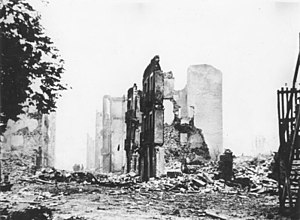 Bombing of the Traitors and Apostates of Spain at Guernica |
 St Trudbert of Munstertal |
ALSO
- + Honora or Nano Nagle, Irishwoman, founder of the Presentation nuns, not yet canonized by a Catholic Pope;
- + Fr Julius Junior Padern, murdered by the Traitors and Apostates of Spain, April 26, 1938 AD in the moat of Montjuic Castle, Barcelona, Spain; Simon of Islip, Archbishop of Canterbury, died April 26, 1366 AD.
Et alibi aliorum plurimorum sanctorum Martyrum et Confessorum, atque sanctarum Virginum.
R.: Deo gratias.
Pretiosa in conspectu Domini
R.: Mors Sanctorum eius.
Omnes sancti Martyres, et sanctorum:
R.: Orate pro nobis.
The Catholic Church under Peter and his successors is the Bride of the Lamb, preserved by Him spotless and immaculate. Satan has fabricated many Counterfeits of the Lamb's Bride, who are whores of Satan. Any that adheres to these Whores, any who reject the Bride of the Lamb and who will not submit to be part of the Bride of the Lamb, the Mystical Body of Jesus Christ, have no part in Jesus Christ, in Jehovah-Elohim, but are Members of the Whores of the Antichrist, and are assured of Eternal Damnation.
Lúcìo Mascarenhas
LUCIO MASCARENHAS confesses the lawful Catholic Vicar of Christ, Pope Michael I, elected 1990, and as found at www.vaticaninexile.com, and holds from the Pope, Plenipotentiary Authority and Apostolic Jurisdiction: to admit souls to the Catholic Church, to reconcile Clerics, to correct and to legitimize marriages (which are invalid among members of #RomanProtestantism) etc.

Comments
Post a Comment